


SEEFOR 17(2): 26020
Article ID: 26020
DOI: https://doi.org/10.15177/seefor.26-020
REVIEW PAPER
Sink, Source, or Equilibrium? Observation Length and Measurement Method Shape Reported Carbon Balance in Old-Growth Forests
Éva Király1,*, Gábor Illés1, Kinga Raszipovits-Esztó1, Attila Borovics1
Addresses:
(1) University of Sopron, Forest Research Institute, Várkerület 30/A, H-9600 Sárvár, Hungary
Citation: Király É, Illés G, Raszipovits-Esztó K, Borovics A, 2026. Sink, Source, or Equilibrium? Observation Length and Measurement Method Shape Reported Carbon Balance in Old-Growth Forests. South-east Eur for 17(2): 26020. https://doi.org/10.15177/seefor.26-020.
Received: 29 Mar 2026; Revised: 16 Jul 2026; Accepted: 22 Jul 2026; Published online: 8 Aug 2026
Cited by: Google Scholar
Abstract
The carbon balance of old-growth forests remains contested, with studies alternately reporting strong carbon sinks, near-equilibrium states, or net carbon sources. Here, we synthesise peer-reviewed evidence to examine whether reported carbon balance classifications are influenced by observation length and measurement method. We conducted a systematic literature review of 60 publications (51 empirical studies and 9 reviews) addressing net carbon balance in old-growth forests. Each empirical study was classified as reporting a net carbon sink, dynamic equilibrium, or net carbon source. Using generalized linear models applied to study-level classifications, we tested the effects of observation length and measurement method on reported carbon balance outcomes. Longer observation periods were associated with higher odds of classifying old-growth forests as operating near dynamic carbon equilibrium; however, this effect did not reach statistical significance. In contrast, measurement method exerted a statistically significant influence: studies based on eddy covariance measurements had nearly twice the odds of classifying forests toward higher carbon uptake categories compared to field-based inventory approaches. Collectively, these results demonstrate that reported carbon balance states of old-growth forests reflect not only ecological processes, but also observational framing, methodological sensitivity, and temporal scale. Our findings caution against simplified narratives portraying old-growth forests as universal carbon sinks or sources, and highlight the need for long-term, methodologically transparent assessments when evaluating forest-based climate mitigation strategies.
Keywords: mature forests; carbon balance; net ecosystem exchange; dynamic equilibrium; eddy covariance; carbon sink; climate mitigation
INTRODUCTION
Limiting global warming requires rapid and sustained reductions in greenhouse gas emissions alongside the protection and enhancement of natural carbon sinks (IPCC 2023a). Ecosystem-based solutions play a central role in climate mitigation strategies by removing carbon dioxide from the atmosphere and storing it in biomass, soils, and long-lived organic matter (IPCC 2023b). Among terrestrial ecosystems, forests are particularly important because they combine large carbon stocks with ongoing carbon exchange processes that can either mitigate or exacerbate climate change, depending on their net balance between uptake and release (Grassi et al. 2017).
A critical distinction in this context is between carbon stocks and carbon sinks. Carbon stocks refer to the amount of carbon stored in an ecosystem at a given time, whereas carbon sinks describe the net flux of carbon from the atmosphere into the ecosystem over a defined period (Köhl and Martes 2023). Large carbon stocks do not necessarily imply ongoing net uptake, and ecosystems with substantial storage may operate near equilibrium or even become net sources under certain conditions (Verkerk et al. 2022, Borovics et al. 2025). This distinction is especially relevant for climate mitigation frameworks, carbon accounting, and policy instruments that increasingly rely on quantified ecosystem carbon fluxes rather than on static carbon storage alone.
Old-growth forests play a central role in global carbon cycling due to their large biomass stocks and long carbon residence times. Classical ecosystem theory suggested that late-successional forests tend to approach carbon neutrality as gains in biomass slow down and respiratory losses balance assimilation (Odum 1969, Gower et al. 1996, Van Tuyl et al. 2005, Wang et al. 2011). In contrast, a growing body of empirical evidence has reported persistent net carbon uptake in some old-growth systems, even at the global scale, challenging the expectation of long-term equilibrium (Carey et al. 2001, Junhui et al. 2006, Luyssaert et al. 2008, 2021, Fei et al. 2018, Keith et al. 2024). As a result, the carbon balance of old-growth forests remains actively debated, with studies variously reporting net sink behaviour, near-equilibrium states, or net carbon sources, depending on ecosystem context, observation period, and methodological approach (Pregitzer and Euskirchen 2004, Chambers et al. 2013, Gundersen et al. 2021).
One proposed explanation for contrasting reports of old-growth forest carbon balance is the diversity of methods used to quantify ecosystem carbon exchange. Field-based inventory approaches estimate carbon balance from repeated measurements of biomass and dead organic matter, typically integrating long temporal scales but with limited resolution of short-term flux dynamics. Eddy covariance (EC) measurements (Baldocchi 2003) quantify net ecosystem exchange of CO2 by measuring high-frequency covariation between vertical wind speed and CO2 concentration above the forest canopy, thereby capturing ecosystem–atmosphere gas exchange at sub-hourly time steps. While this approach provides direct, continuous flux estimates, it requires substantial post-processing and is sensitive to atmospheric conditions, gap-filling procedures, and methodological assumptions. Process-based ecosystem models integrate carbon fluxes and pools across time and space but rely on parameterisation and structural assumptions, while remote sensing provides spatially extensive indicators of productivity and disturbance that must be indirectly linked to carbon balance. Each approach captures different components and temporal scales of the forest carbon cycle, complicating direct comparison among studies.
These methodological differences are highly relevant for climate mitigation strategies. Old-growth forests are frequently cited as key natural climate solutions (Luyssaert et al. 2008, 2010, Keith et al. 2024), yet uncertainty (Gundersen et al. 2021) about whether they function as persistent sinks, dynamic equilibria, or intermittent sources affects how they are represented in carbon accounting frameworks, mitigation scenarios, and policy narratives. If reported sink behaviour is sensitive to observation length or measurement method, then conclusions about the mitigation role of old-growth forests may reflect observational framing as much as underlying ecosystem processes.
In this study, we synthesise peer-reviewed evidence on the carbon balance of old-growth forests to examine whether reported classifications as carbon sinks, near-equilibrium systems, or carbon sources are systematically shaped by observation length and measurement method. Using a systematic literature review and classification-based statistical analyses, we test whether shorter observation periods are more likely to yield sink or source classifications and whether eddy covariance and field-based approaches differ in their reported carbon balance outcomes. By explicitly focusing on methodological influences, this study aims to clarify sources of divergence in the old-growth forest carbon balance literature and to support more robust interpretation of forest-based climate mitigation evidence.
MATERIALS AND METHODS
Literature Search and Study Selection
A systematic literature search was conducted using the Web of Science Core Collection and Scopus databases to identify peer-reviewed literature addressing the net carbon balance of old-growth forests. The search strategy combined terms related to forest developmental status (e.g. old-growth, primary, unmanaged, mature forests), carbon cycle processes (carbon sequestration, carbon sink, carbon source, carbon balance), and net ecosystem carbon metrics (net ecosystem productivity, net ecosystem exchange, NEP, NEE, NBP).
This systematic review was conducted in accordance with the PRISMA 2020 guidelines (Page et al. 2021). The review protocol was not registered in PROSPERO due to scope limitations but is fully described in the Methods and Supplementary Materials.
Searches were restricted to articles and review papers published in English. No temporal restrictions were applied. The complete database-specific search strings and applied filters are provided in Supplementary Material S1. All records retrieved from the two databases were exported, merged, and de-duplicated prior to screening. Study selection followed a two-stage process consisting of (i) title and abstract screening and (ii) full-text eligibility assessment.
Both original research articles and review papers were eligible for inclusion. Original research studies were required to explicitly address old-growth, primary, unmanaged, or equivalent mature forest systems and to report empirical information on net carbon balance, including net ecosystem exchange (NEE), net ecosystem productivity (NEP), net biome productivity (NBP), or changes in ecosystem carbon stocks.
Review articles were included if they synthesised empirical evidence on carbon dynamics in old-growth or primary forests and contributed to the interpretation of mechanisms underlying continued carbon sequestration, equilibrium, or net carbon emissions. Studies focusing exclusively on intensively managed forests or plantations, lacking a clear definition of forest developmental status, or reporting only static carbon stocks without information on temporal change were excluded. Conceptual or opinion papers without synthesis of empirical evidence were also excluded at the full-text screening stage. The detailed process of study identification, screening, eligibility assessment, and final inclusion is illustrated in the PRISMA flow diagram (Figure 1).
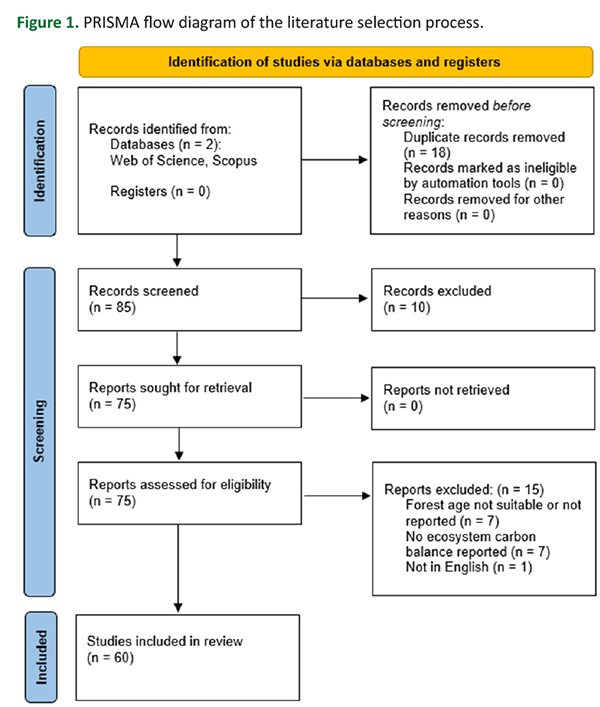 Figure 1. PRISMA flow diagram of the literature selection process.
A total of 85 studies were screened following database searches and de-duplication. Of these, 25 were excluded during title, abstract, or full-text screening because they did not meet the eligibility criteria, leaving 60 studies that addressed the carbon balance of old-growth forests. This final corpus comprised 51 original empirical studies and 9 review articles. The distribution of the examined studies by biome is shown in Table 1.
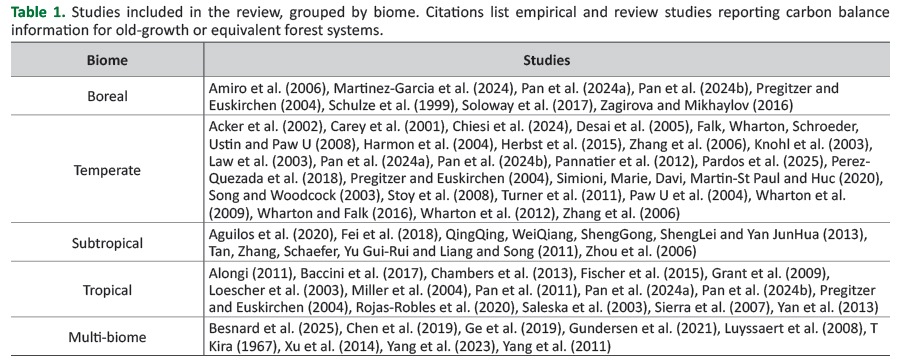
Data Extraction and Synthesis
For all studies meeting the eligibility criteria, relevant information was systematically extracted using a predefined data-extraction table (Supplementary Material S2). Extracted variables included publication year, biome, forest type, methodological approach, carbon pools considered, carbon balance metric, reported net carbon balance, temporal coverage of observations, disturbance regime, and additional study-specific notes.
Each empirical study was further classified according to the reported direction of net carbon balance (net carbon sink, near-equilibrium, or net carbon source). Studies were classified as near-equilibrium when the reported net ecosystem carbon balance did not differ meaningfully from zero over the observation period, based on the authors’ interpretation or reported uncertainty ranges. Review articles were used to support the interpretation of observed patterns and to identify areas of consensus and disagreement in the literature.
Extracted data were synthesised qualitatively to identify consistent patterns across biomes, forest types, methodological approaches, and disturbance conditions. A quantitative meta-analysis was not conducted due to heterogeneity in reported metrics, temporal coverage, and system definitions across studies. Instead, the extracted study-level classifications were analysed using generalized linear models to test the effects of observation length and measurement method on reported carbon balance outcomes. Each observation in the statistical analyses represents a single study-level classification of carbon balance for an independent forest site or site aggregate as reported in the original publication.
Statistical Analysis of Carbon Balance Classification
Binary Analysis of Equilibrium Classification
To assess whether the length of the observation period influences the likelihood of classifying old-growth forests as being in carbon balance, we applied a generalized linear modeling framework with a binomial error distribution and logit link function. Forest carbon balance was coded as a binary response variable, where equilibrium states were coded as 1 and non-equilibrium states (carbon source or sink) as 0.
This binary grouping was used because the specific objective of this analysis was to distinguish apparent equilibrium from directional carbon imbalance, irrespective of the direction of that imbalance. Carbon sources and sinks therefore represented a common “non-equilibrium” category only for this particular analysis. We acknowledge that source and sink states have different ecological implications; consequently, their distinction was retained and examined separately in the ordinal source–equilibrium–sink analysis described below.
Measurement duration (T, years) was log-transformed prior to analysis to reduce the leverage of very long time series and to model proportional (multiplicative) effects of increasing observation length. The resulting predictor therefore captures changes in equilibrium classification associated with relative rather than absolute increases in measurement duration.
Initial models included biome and measurement method as categorical predictors; however, these models exhibited quasi-complete separation due to sparse category combinations and limited sample size. To ensure numerical stability and parsimonious inference, final analyses focused on a reduced model including measurement duration as the sole predictor. Model significance was evaluated using likelihood ratio (Type III) tests, and effect sizes were reported as odds ratios with 95% confidence intervals. All analyses were conducted in Statistica software (Version 14.0.1.25, Tulsa, OK, USA) using generalized linear models.
Ordinal Analysis of Source–Sink Classification
To evaluate whether the measurement method influences the classification of forest carbon balance along an ordered gradient, we applied an ordinal logistic regression (proportional odds model). Carbon balance was treated as an ordered categorical response variable with three levels reflecting increasing net carbon uptake: source (1) < equilibrium (2) < sink (3). Measurement method was included as a categorical predictor with two levels, with field-based measurements specified as the reference category and eddy covariance as the alternative. The model was fitted using an ordinal multinomial error distribution with a logit link function, as implemented in the Generalized Linear/Nonlinear Models (GLZ) module of Statistica.
The proportional odds assumption implies a single, constant effect of measurement method across the cumulative thresholds separating the ordered response categories. This assumption was assessed by examining whether the direction and magnitude of the method effect were consistent across cumulative thresholds, supporting the use of a single ordinal effect. Statistical significance of the predictor was assessed using Type III likelihood ratio tests, while parameter estimates and Wald statistics were used to quantify the direction and magnitude of the effect. Effect sizes were reported as odds ratios (OR) with 95% confidence intervals (CI), and statistical significance was evaluated at α = 0.05.
RESULTS
Characteristics of the Reviewed Studies
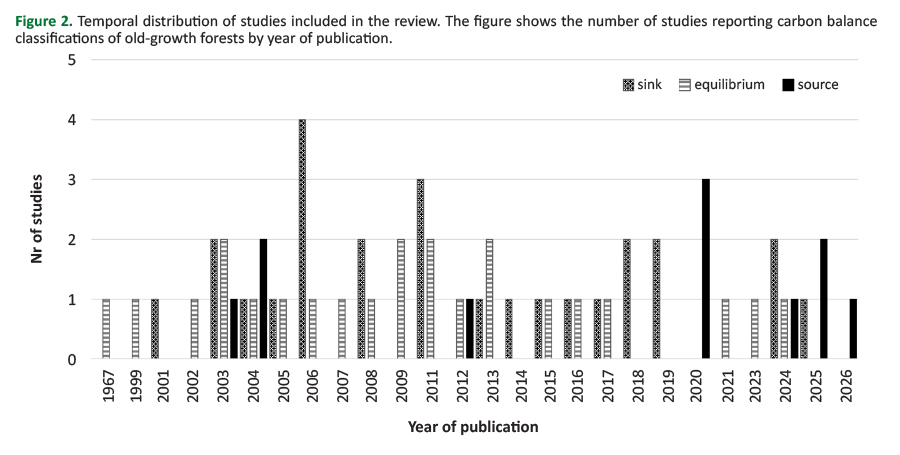
The reviewed literature spans more than five decades, with the earliest study published in 1967 and the majority of studies appearing after 2000. The temporal distribution of publications shows a gradual increase in research activity, particularly from the early 2000s onward (Figure 2). Across the full time series, studies reported all three carbon balance states: sink, dynamic equilibrium, and source. Sink classifications appear to be more frequent in studies published during the last decade.
The methodological approaches used to quantify carbon balance varied considerably among studies. Eddy covariance measurements represented the most frequently applied empirical method, followed by field-based carbon stock change assessments. A smaller number of studies relied on remote sensing approaches or modelling frameworks.
Synthesis of Reported Carbon Balance States in Old-Growth Forests
Among the examined studies, 26 classified old-growth forests as net carbon sinks, 11 reported net carbon sources, and 23 described systems operating close to dynamic carbon equilibrium. When equilibrium and source classifications were combined as non-sink outcomes, 34 studies fell into the non-sink category. Overall, these results indicate substantial variability in reported carbon balance states of old-growth forests across the literature, with sink, source, and near-equilibrium classifications all well represented.
Across biomes, the relative distribution of carbon balance classifications showed pronounced variation (Figure 3). Boreal forests were most frequently reported as operating near dynamic equilibrium, with a substantial proportion also classified as net carbon sources, while sink classifications were comparatively rare. In temperate forests, net carbon sinks dominated, although dynamic equilibrium classifications remained common and source classifications were less frequent. Subtropical forests exhibited the strongest dominance of sink classifications, with the majority of studies reporting net carbon uptake and only a small fraction identifying source or equilibrium states.
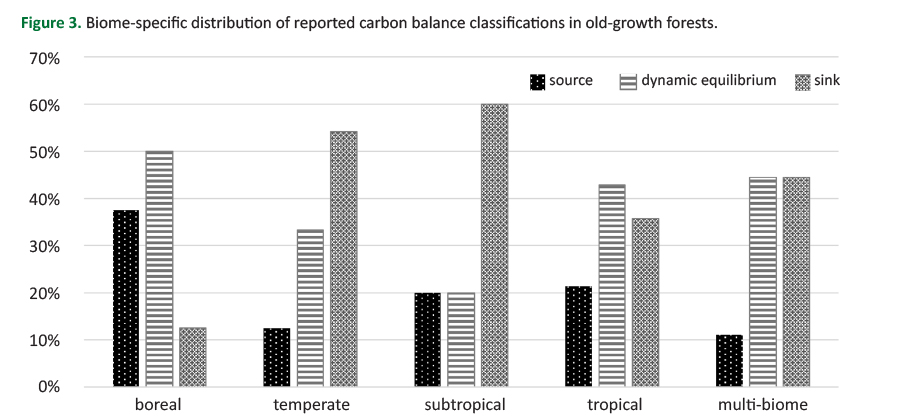
In tropical forests, all three carbon balance categories were well represented, but dynamic equilibrium and sink classifications together outweighed source classifications. Multi-biome synthesis studies showed a roughly even distribution between sink and dynamic equilibrium outcomes, with relatively few source classifications. Overall, the figure highlights that the reported carbon balance states of old-growth forests differ systematically among biomes, with sink dominance most pronounced in subtropical systems and equilibrium or source classifications more prevalent in boreal forests.
Effect of Measurement Duration on Equilibrium Classification
The binary logistic regression was fitted to 60 empirical observations. Measurement duration showed a consistent positive association with the probability of classifying old-growth forests as being in carbon balance. However, this effect did not reach conventional levels of statistical significance (likelihood ratio χ² = 0.80, df = 1, p = 0.37), and the 95% confidence interval for the regression coefficient included 0 (β = 0.30, 95% CI −0.30 to 0.78).
Longer observation periods increased the odds of equilibrium classification, with an estimated odds ratio of approximately 1.35 per unit increase in log-transformed measurement duration, corresponding to an approximately 2.7-fold increase in monitoring length (Figure 4).
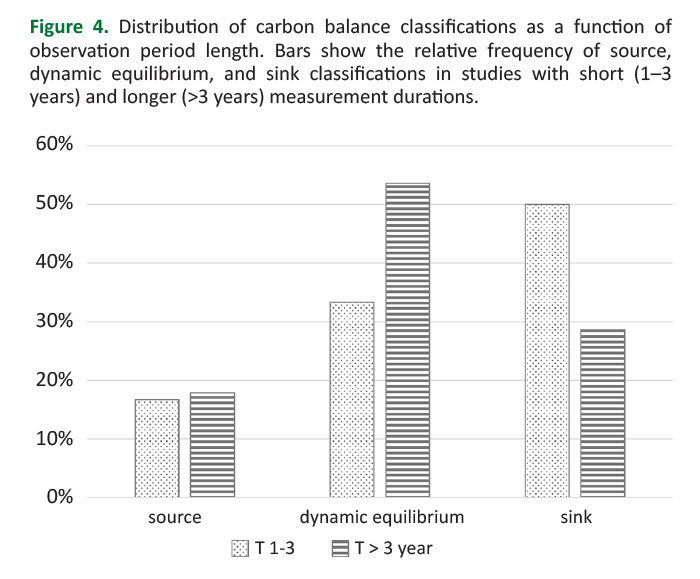
For the descriptive presentation in Figure 4, studies were grouped into short (1–3 years) and longer (>3 years) observation periods, distinguishing studies based on a few annual carbon-balance estimates from those capturing longer interannual variation. This grouping was used only for visual comparison of classification frequencies; in the logistic regression, measurement duration was retained as a continuous, log-transformed variable.
These results indicate a directionally consistent but statistically uncertain effect, likely reflecting limited statistical power and substantial heterogeneity among studies. Overall, the analysis suggests that shorter observation periods are more likely to yield classifications of old-growth forests as carbon sources or sinks, whereas longer time series increasingly support interpretations of dynamic carbon equilibrium.
Effect of Measurement Method on Ordered Carbon Balance Classification
The ordinal logistic regression included 39 empirical observations. The ordinal logistic regression revealed a significant effect of measurement method on carbon balance classification along the ordered gradient from source to sink (Type III likelihood ratio test: χ² = 4.10, df = 1, p = 0.043).
Parameter estimates indicated that the eddy covariance method was associated with significantly higher odds of assigning forests to higher carbon balance categories compared to field-based measurements. The estimated regression coefficient for measurement method was positive (β = 0.624), corresponding to an odds ratio of approximately 1.87. This indicates that observations based on eddy covariance measurements had nearly twice the odds of being classified in a higher category (equilibrium rather than source, and sink rather than equilibrium or source) relative to field-based methods (Wald p = 0.006) (Figure 5).
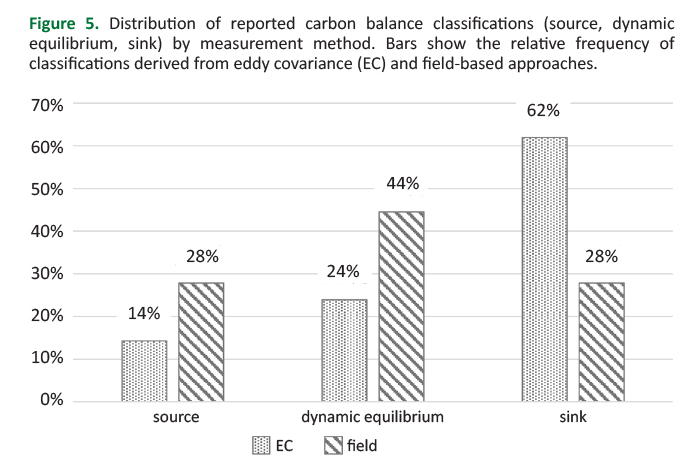
The 95% confidence interval for the odds ratio did not include 1 (OR ≈ 1.01–3.46), confirming the statistical significance of the effect. Overall, these results demonstrate a systematic methodological influence on reported carbon balance status, with eddy covariance studies more frequently classifying forests toward the sink end of the ordered spectrum.
DISCUSSION
Across reviewed studies, sink, source, and dynamic equilibrium outcomes were well represented, underscoring that old-growth forests do not exhibit a uniform carbon balance but rather show substantial variability. However, the contrasting classifications appear to be shaped in part by differences in observation length and measurement method.
Observation Length and the Stability of Carbon Balance Interpretation
Our analyses indicate that observation length influences the stability of carbon balance interpretation in old-growth forests. Longer monitoring periods were associated with higher odds of classifying forests as operating near dynamic equilibrium, whereas shorter observation periods more frequently yielded sink or source classifications. Although this relationship did not reach statistical significance, its consistent direction suggests that short-term measurements may disproportionately capture interannual variability or transient responses, while longer time series increasingly support interpretations of long-term carbon balance.
Annual net carbon exchange in old-growth forests can vary substantially in response to climate oscillations, weather anomalies, and episodic disturbances. In temperate conifer forests, large-scale teleconnection phases caused stands to alternate between sink and source states (Wharton et al. 2009, 2012, Wharton and Falk 2016). Old-growth Amazon forests generally remained close to carbon neutrality when flux measurements, biometric inventories, and modelling were considered together, although ENSO events produced temporary sink or source states (Grant et al. 2009). Similarly, El Niño-related heat and drought reduced photosynthesis and shifted a tropical forest toward net carbon loss (Loescher et al. 2003). Drought- and temperature-driven switches were also observed in old-growth Douglas-fir forests (Falk et al. 2008) and South American temperate rainforests (Perez-Quezada et al. 2018). In tropical dry forests, persistent water limitation may maintain source behavior even without major disturbances (Rojas-Robles et al. 2020), while episodic mortality can produce temporary carbon losses in otherwise near-equilibrium Amazon forests (Saleska et al. 2003).
These findings indicate that short observation periods may capture climate-specific, or disturbance-driven source and sink states rather than long-term ecosystem behavior. Longer records integrate a broader range of climatic conditions and disturbance effects and may therefore provide more stable estimates of long-term carbon balance. This mechanism is consistent with the directional, although statistically non-significant, association between observation length and equilibrium classification identified in our synthesis.
Measurement Method as a Source of Systematic Classi-fication Bias
In contrast to observation length, measurement method exerted a statistically significant influence on reported carbon balance classification along the ordered gradient from source to sink. Within the relatively small sample of studies, eddy covariance measurements were more frequently associated with classifications indicating higher carbon uptake than field-based approaches. These findings point out that reported carbon balance states of old-growth forests reflect not only ecological processes, but also how and over what temporal scale those processes are observed.
A key methodological explanation for the tendency of eddy covariance studies to classify old-growth forests toward the sink end of the carbon balance spectrum lies in the sensitivity of annual EC balances to the treatment of nocturnal fluxes. Under stable atmospheric conditions and weak turbulence, a substantial fraction of ecosystem respiration can be transported by advective and storage processes that are not captured by standard EC measurements, leading to systematic underestimation of nighttime CO2 efflux. As a result, annual net ecosystem exchange estimates can be highly sensitive to the application of friction-velocity (u*) filtering and gap-filling strategies, with relatively small methodological choices producing large shifts in inferred annual carbon balance.
This sensitivity is well illustrated by the analysis of an old-growth Amazon forest presented by Miller et al. (2004). In that study, the uncorrected EC record initially suggested a strong carbon sink (approximately −3.9 Mg·C·ha-1·yr-1). However, the authors demonstrated that this signal was largely an artefact of underestimated nocturnal respiration under calm night conditions. When nighttime fluxes were corrected using an appropriate u* threshold and seasonally adjusted respiration estimates, the inferred annual carbon balance shifted by more than 4 Mg·C·ha-1·yr-1, yielding a near-neutral to slightly positive net carbon balance (+0.4 Mg·C·ha-1·yr-1). Importantly, this corrected EC estimate aligned with independent biometric inventories spanning multiple decades, which likewise indicated that the forest was not a persistent carbon sink.
This example highlights that apparent sink signals in EC-based studies of old-growth forests can, in some cases, arise from methodological sensitivity rather than sustained ecosystem carbon accumulation. In contrast, field-based inventory approaches typically integrate carbon dynamics over longer temporal scales and are not sensitive to short-term atmospheric conditions and turbulence regimes. This difference in temporal integration and observational sensitivity may partly explain the greater tendency of field-based studies to classify old-growth forests as operating near dynamic equilibrium or as weak carbon sources. Together, these considerations support the interpretation that the significant method effect detected in the ordinal regression likely reflects differences in observational framing and methodological sensitivity, rather than systematic differences in underlying ecosystem behaviour.
Biome-Specific Patterns in Reported Carbon Balance
Reported carbon balance classifications varied markedly among biomes. Boreal systems were more frequently classified as near equilibrium or net carbon sources, consistent with high climatic responsiveness, large soil carbon pools, and the prevalence of disturbance legacies in long-lived stands. In subtropical forests, sink classifications dominated the literature, reflecting both favourable climatic conditions for sustained photosynthesis and the concentration of studies conducted during climatically benign periods (Tan et al. 2011, Fei et al. 2018).
Temperate and tropical forests displayed the widest range of reported outcomes, spanning sink, equilibrium, and source classifications. This variability likely reflects the combined influence of pronounced interannual climate variability, episodic disturbances, and differences in observation length and measurement method across studies (Pannatier et al. 2012, Baccini et al. 2017, Pardos et al. 2025). Taken together, these patterns indicate that biome-level summaries of old-growth forest carbon balance largely reflect the interaction of climate variability, disturbance history, and observational framing, rather than stable, biome-specific carbon balance states.
Conceptual Expectation of Dynamic Equilibrium in Old-Growth Forests across Space and Time
Based on fundamental physical and ecological constraints, sufficiently extensive old-growth forest landscapes observed over sufficiently long time horizons are expected to approach approximate CO2 equilibrium with the atmosphere, provided that boundary conditions, including radiative forcing, atmospheric composition, and the fundamental energy and material throughput of the system, remain relatively stationary. This expectation is consistent not only with classical ecosystem development theory (Odum 1969), but also with the conservation of mass and energy, reflected in ecology by the concept of a site-specific ultimate yield (constant final yield) (Yoda 1963, Kira 1967). Under a given climate regime, incoming solar radiation, plant-available water, and soil nutrient-supply capacity constrain the maximum standing biomass that can be maintained per unit area. In the absence of such constraints, indefinite biomass accumulation would be theoretically possible, which is physically implausible in closed and resource-limited systems.
Importantly, this equilibrium is dynamic rather than static. Carbon balance and standing biomass fluctuate around a site-specific potential as natural disturbances, mortality events, gap formation, and regeneration processes unfold through time. The same forest type may therefore appear as a net carbon source during phases of elevated mortality or structural collapse, and as a net sink when growth and recruitment dominate (Turner 2010). This temporal alternation supports the interpretation that carbon balance classifications derived from short observation windows may disproportionately capture transient states, whereas longer monitoring periods increasingly integrate internal forest dynamics with interannual climate variability, resulting in a greater likelihood of near-neutral classifications. A comparable convergence toward near-neutrality would be expected under broader spatial integration, because asynchronous patch dynamics within disturbance mosaics can offset one another when the sampled area approaches the spatial scale of landscape-level processes.
A further complication is that most of the empirical evidence synthesized in this article originates from the post-2000 period, during which environmental conditions have become increasingly non-stationary (Turner 2010). Atmospheric CO2 concentrations, temperature regimes, drought frequency, and disturbance patterns have shifted, suggesting that many forest systems may be displaced from their historical dynamic equilibrium and are undergoing transient adjustment toward new site-specific potentials. Under this interpretation, the observed mixture of sink, source, and near-equilibrium classifications reflects not only internal forest dynamics and methodological framing, but also directional ecosystem responses to altered boundary conditions. In cases when climate change reduces attainable biomass or increases mortality and disturbance risk, source classifications may become more frequent. Also, when constraints are relaxed, such as through extended growing seasons or CO2 fertilization under adequate water and nutrient availability, sink classifications may dominate, at least temporarily. Reported carbon balance states should therefore be interpreted as scale- and context-dependent observational outcomes shaped by time horizon, measurement approach, and the degree of environmental stationarity, rather than as fixed intrinsic properties of old-growth forest ecosystems.
The Role of Old-Growth Forests in Climate Change Miti-gation
Our synthesis demonstrates that old-growth forests cannot be uniformly characterised as persistent carbon sinks. While sink behaviour is frequently reported, particularly in subtropical systems and in studies based on eddy covariance, near-equilibrium and source states are also common. Treating old-growth forests as inherently superior mitigation assets may lead to suboptimal policy choices if assessments focus exclusively on in situ forest carbon stocks while neglecting harvested wood products (HWP) and material and energy substitution effects. Recent analyses indicate that, outside strictly protected conservation areas, managed forest systems can deliver greater long-term climate mitigation benefits than unmanaged stands provided that carbon storage in HWPs and the substitution of fossil-intensive materials are accounted for (Leskinen et al. 2018, Borovics et al. 2024). This does not diminish the ecological or conservation value of old-growth forests, but highlights that their climate mitigation role differs fundamentally from that of actively managed systems. Jansons et al. (2025) showed that although old-growth stands in Latvia contained, on average, higher tree biomass carbon stocks than managed stands, the total climate mitigation effect of managed forests, when combining standing biomass, harvested wood products, and substitution effects, was significantly greater over comparable time horizons. These findings are consistent with broader evidence indicating that forest growth rates and biomass accumulation slow with increasing stand age (Gower et al. 1996, Van Tuyl et al. 2005, Wang et al. 2011). Additionally, in regions approaching xeric forest limits, such as parts of Central Europe, old-growth forests adapted to cooler and wetter climatic conditions may become increasingly vulnerable to drought-induced decline, elevated mortality, and potential carbon losses under future climate scenarios (Illés and Móricz 2022). In such contexts, reliance on static carbon storage in old-growth stands may entail higher long-term emission risks than strategies that actively manage forest structure, regeneration, and wood use in ways that enhance adaptive capacity and system resilience.
Land-based (LULUCF) greenhouse gas accounting further underscores the risks of over-interpreting short-term carbon balance estimates when designing mitigation strategies. Large and persistent discrepancies remain between global model estimates and national greenhouse gas inventories in the LULUCF sector (Deng et al. 2022, Grassi et al. 2022b,a), particularly for forest land, with differences exceeding 6 Gt·CO2·yr-1 at the global scale for the period 2000–2020 (Grassi et al. 2023). These mismatches arise from fundamentally different conceptual definitions of anthropogenic versus natural fluxes, the delineation of managed forests, and the attribution of indirect human-induced effects such as CO2 fertilisation. As a result, reported forest sinks may reflect accounting conventions as much as underlying biophysical processes, and apparent short-term mitigation gains can be highly sensitive to methodological framing. Prioritising transient net carbon balances, especially in mature or old-growth forests characterised by large but opposing carbon fluxes, therefore risks overstating mitigation certainty. The observed variability in reported carbon-balance states supports calls for transparent, consistent, and robust land-sector accounting (Grassi et al. 2023). More broadly, credible forest-based mitigation strategies may need to consider not only short-term in situ carbon uptake, but also the long-term persistence and climate resilience of forest carbon stocks, regeneration capacity, and the continued provision of renewable materials. These implications should be regarded as policy-relevant interpretations informed by the wider literature rather than as empirical conclusions directly tested by the present synthesis.
Methodological Limitations and Scope
This study synthesises heterogeneous evidence using classification-based analyses rather than an effect-size meta-analysis, reflecting substantial variation in metrics, temporal coverage, and system definitions across studies. Classification into carbon sink, equilibrium, and source categories was based partly on the interpretations provided by the authors of the original publications, together with the reported estimates and available uncertainty information. Consequently, some degree of subjectivity and inconsistency among studies may remain, particularly where statistical uncertainty was incompletely reported or where the distinction between equilibrium and a weak source or sink was not clearly defined. Sample sizes also limited the inclusion of additional predictors in the statistical models. Despite these constraints, the approach provides meaningful insight into how observation length and measurement method influence the reported outcomes, and the results should be interpreted as addressing patterns in reported carbon balance classifications, rather than definitive estimates of underlying ecosystem carbon dynamics.
CONCLUSIONS
This synthesis shows that old-growth forests cannot be uniformly classified as persistent carbon sinks; reported states span sink, near-equilibrium, and source categories. However, when interpreted in light of ecological theory and biophysical constraints, these contrasting outcomes are most consistently understood as fluctuations around a dynamic carbon equilibrium. Shorter observation periods more frequently yield sink or source classifications, likely reflecting transient disturbance phases or interannual climate variability, whereas longer monitoring durations increasingly support near-neutral outcomes. Measurement method exerted a statistically significant influence, with eddy covariance studies more often classifying forests toward higher uptake categories than field-based approaches, underscoring the role of methodological sensitivity and temporal integration.
Taken together, our findings emphasize that interpreting old-growth forests as universal carbon sinks risks oversimplification, potentially leading to suboptimal climate mitigation strategies if life-cycle carbon effects, harvested wood products, substitution benefits, and climate risks are not considered. Robust assessment of forest-based mitigation requires long-term, methodologically transparent, and integrated approaches that distinguish conservation value from climate mitigation effectiveness.
Author Contributions
Conceptualization, AB; methodology, EK; validation, AB and GI; formal analysis, EK; investigation, EK, KR-E and AB.; writing – original draft preparation, EK; writing – review and editing, AB, GI and KR-E; visualization, EK; supervision, AB; project administration, AB; funding acquisition, AB. All authors have read and agreed to the published version of the manuscript
Funding
This article was made in the framework of project TKP2021-NKTA-43, which has been implemented with the support provided by the Ministry of Culture and Innovation of Hungary from the National Research, Development and Innovation Fund, financed under the TKP2021-NKTA funding scheme.
Conflicts of Interest
The authors declare no conflict of interest.
Supplementary Materials
Supplementary Material S1. Search strategy.
Supplementary Material S2. Study screening and data-extraction table (structure).
REFERENCES
Acker SA, Halpern CB, Harmon ME, Dyrness CT, 2002. Trends in bole biomass accumulation, net primary production and tree mortality in Pseudotsuga menziesii forests of contrasting age. Tree Physiol 22: 213–217. https://doi.org/10.1093/treephys/22.2-3.213.
Aguilos MM, Mitra B, Noormets A, Minick K, Prajapati P, Gavazzi M, Sun G, McNulty S, Li X, Domec JC, Miao G, 2020. Long-term carbon flux and balance in managed and natural coastal forested wetlands of the Southeastern USA. Agric For Meteorol 288–289: 108022. https://doi.org/10.1016/j.agrformet.2020.108022.
Alongi DM, 2011. Carbon payments for mangrove conservation: ecosystem constraints and uncertainties of sequestration potential. Environ Sci Policy 14: 462–470. https://doi.org/10.1016/j.envsci.2011.02.004.
Amiro BD, Barr AG, Black TA, Iwashita H, Kljun N, McCaughey JH, Morgenstern K, Murayama S, Nesic Z, Orchansky AL, Saigusa N, 2006. Carbon, energy and water fluxes at mature and disturbed forest sites, Saskatchewan, Canada. Agric For Meteorol 136: 237–251. https://doi.org/10.1016/j.agrformet.2004.11.012.
Baccini A, Walker W, Carvalho L, Farina M, Sulla-Menashe D, Houghton RA, 2017. Tropical forests are a net carbon source based on aboveground measurements of gain and loss. Science 358: 230–234. https://doi.org/10.1126/science.aam5962.
Baldocchi DD, 2003. Assessing the eddy covariance technique for evaluating carbon dioxide exchange rates of ecosystems: past, present and future. Glob Change Biol 9: 479–492. https://doi.org/10.1046/j.1365-2486.2003.00629.x.
Besnard S, Heinrich VHA, Carvalhais N, Ciais P, Herold M, Luijkx I, Peters W, Requena Suarez D, Santoro M, Yang H, 2025. Global covariation of forest age transitions with the net carbon balance. Nat Ecol Evol 9: 1848–1860. https://doi.org/10.1038/s41559-025-02821-5.
Borovics A, Király É, Kottek P, 2024. Projection of the carbon balance of the Hungarian forestry and wood industry sector using the Forest Industry Carbon Model. Forests 15(4): 600. https://doi.org/10.3390/f15040600.
Borovics Á, Király É, Keserű Z, Schiberna E, 2025. Balancing climate change adaptation and mitigation through forest management choices—A case study from Hungary. Forests 16(11):1724. https://doi.org/10.3390/f16111724.
Carey EV, Sala A, Keane R, Callaway RM, 2001. Are old forests underestimated as global carbon sinks? Glob Change Biol 7:339–344. https://doi.org/10.1046/j.1365-2486.2001.00418.x.
Chambers JQ, Negron-Juarez RI, Marra DM, Di Vittorio A, Tews J, Roberts D, Ribeiro GH, Trumbore SE, Higuchi N, 2013. The steady-state mosaic of disturbance and succession across an old-growth Central Amazon forest landscape. Proc Natl Acad Sci U S A 110: 3949–3954. https://doi.org/10.1073/pnas.1202894110.
Chen QQ, Xu WQ, Li SG, Fu S, Yan j, 2013. Aboveground biomass and corresponding carbon sequestration ability of four major forest types in south China. Chin Sci Bull 58: 1551–1557. https://doi.org/10.1007/s11434-012-5100-8.
Chen Z, Yu G, Wang Q, 2019. Magnitude, pattern and controls of carbon flux and carbon use efficiency in China’s typical forests. Glob Planet Change 172: 464–473. https://doi.org/10.1016/j.gloplacha.2018.11.004.
Chiesi M, Fibbi L, Vanucci S, Maselli F, 2024. Use of remote sensing and biogeochemical modeling to simulate the impact of climatic and anthropogenic factors on forest carbon fluxes. Remote Sens 16(2): 232. https://doi.org/10.3390/rs16020232.
Deng Z, Ciais P, Tzompa-Sosa ZA, Saunois M, Qiu C, Tan C, Sun T, Ke P, Cui Y, Tanaka K, Lin X, 2022. Comparing national greenhouse gas budgets reported in UNFCCC inventories against atmospheric inversions. Earth Syst Sci Data 14: 1639–1675. https://doi.org/10.5194/essd-14-1639-2022.
Desai AR, Bolstad PV, Cook BD, Davis KJ, Carey EV, 2005. Comparing net ecosystem exchange of carbon dioxide between an old-growth and mature forest in the upper Midwest, USA. Agric For Meteorol 128: 33–55. https://doi.org/10.1016/j.agrformet.2004.09.005.
Falk M, Wharton S, Schroeder M, Ustin SL, Paw U KT, 2008. Flux partitioning in an old-growth forest: seasonal and interannual dynamics. Tree Physiol 28(4): 509–520. https://doi.org/10.1093/treephys/28.4.509.
Fei X, Song Q, Zhang Y, Liu Y, Sha L, Yu G, Zhang L, Duan C, Deng Y, Wu C, Lu Z, 2018. Carbon exchanges and their responses to temperature and precipitation in forest ecosystems in Yunnan, Southwest China. Sci Total Environ 616–617: 824–840. https://doi.org/10.1016/j.scitotenv.2017.10.239.
Fischer R, Ensslin A, Rutten G, Fischer M, Schellenberger Costa D, Kleyer M, Hemp A, Paulick S, Huth A, 2015. Simulating carbon stocks and fluxes of an African tropical montane forest with an individual-based forest model. PLoS One 10(4): e0123300. https://doi.org/10.1371/journal.pone.0123300.
Ge R, He H, Ren X, Zhang L, Yu G, Smallman TL, Zhou T, Yu SY, Luo Y, Xie Z, Wang S, 2019. Underestimated ecosystem carbon turnover time and sequestration under the steady state assumption: A perspective from long-term data assimilation. Glob Change Biol 25: 938–953. https://doi.org/10.1111/gcb.14547.
Gower ST, McMurtrie RE, Murty D, 1996. Aboveground net primary production decline with stand age: Potential causes. Trends Ecol Evol 11: 378–382. https://doi.org/10.1016/0169-5347(96)10042-2.
Grant RF, Hutyra LR, de Oliveira RC, Munger JW, Saleska SR, Wofsy SC, 2009. Modeling the carbon balance of Amazonian rain forests: Resolving ecological controls on net ecosystem productivity. Ecol Monogr 79: 445–463. https://doi.org/10.1890/08-0074.1.
Grassi G, Conchedda G, Federici S, Abad Viñas R, Korosuo A, Melo J, Rossi S, Sandker M, Somogyi Z, Vizzarri M, Tubiello FN, 2022a. Carbon fluxes from land 2000–2020: Bringing clarity to countries’ reporting. Earth Syst Sci Data 14: 4643–4666. https://doi.org/10.5194/essd-14-4643-2022.
Grassi G, House J, Dentener F, Federici S, Den Elzen M, Penman J, 2017. The key role of forests in meeting climate targets requires science for credible mitigation. Nat Clim Chang 7: 220–226. https://doi.org/10.1038/nclimate3227.
Grassi G, Schwingshackl C, Gasser T, et al., 2022b. Mapping land-use fluxes for 2001–2020 from global models to national inventories. Earth Syst Sci Data Discuss. https://doi.org/10.5194/essd-2022-245.
Grassi G, Schwingshackl C, Gasser T, Houghton RA, Sitch S, Canadell JG, Cescatti A, Ciais P, Federici S, Friedlingstein P, Kurz WA, et al., 2023. Harmonising the land-use flux estimates of global models and national inventories for 2000–2020. Earth Syst Sci Data 15(3): 1093–1114. https://doi.org/10.5194/essd-15-1093-2023.
Gundersen P, Thybring EE, Nord-Larsen T, Vesterdal L, Nadelhoffer KJ, Johannsen VK, 2021. Old-growth forest carbon sinks overestimated. Nature 591: E21–E23. https://doi.org/10.1038/s41586-021-03266-z.
Harmon ME, Bible KJ, Ryan MG, Shaw DC, Chen H, Klopatek J, Li X, 2004. Production, respiration, and overall carbon balance in an old-growth Pseudotsuga–Tsuga forest ecosystem. Ecosystems 7: 498–512. https://doi.org/10.1007/s10021-004-0140-9.
Herbst M, Mund M, Tamrakar R, Knohl A, 2015. Differences in carbon uptake and water use between a managed and an unmanaged beech forest in central Germany. For Ecol Manage 355: 101–108. https://doi.org/10.1016/j.foreco.2015.05.034.
Illés G, Móricz N, 2022. Climate envelope analyses suggest significant rearrangements in the distribution ranges of Central European tree species. Ann For Sci 79: 35. https://doi.org/10.1186/s13595-022-01154-8.
IPCC, 2023a. Climate Change 2023: Synthesis Report. Contribution of Working Groups I, II and III to the Sixth Assessment Report of the Intergovernmental Panel on Climate Change. Core Writing Team, Lee H, Romero J (eds). IPCC, Geneva, Switzerland, 184 p. https://doi.org/10.59327/IPCC/AR6-9789291691647.
IPCC, 2023b. Agriculture, Forestry and Other Land Uses (AFOLU). Cambridge University Press, Cambridge, UK.
Jansons Ā, Ķēniņa L, Jaunslaviete I, Bičkovskis K, 2025. Trade-off between forest carbon sink in hemiboreal old-growth stands and wood-based solutions. Eur J For Res 144: 411–420. https://doi.org/10.1007/s10342-025-01766-5.
Keith H, Kun Z, Hugh S, Svoboda M, Mikoláš M, Adam D, Bernatski D, Blujdea V, Bohn F, Camarero JJ, Demeter L, et al., 2024. Carbon carrying capacity in primary forests shows potential for mitigation achieving the European Green Deal 2030 target. Commun Earth Environ 5: 256. https://doi.org/10.1038/s43247-024-01416-5.
Kira T, Shidei T, 1967. Primary production and turnover of organic matter in different forest ecosystems of the western Pacific. Jpn J Ecol 17: 70–87.
Knohl A, Schulze ED, Kolle O, Buchmann N, 2003. Large carbon uptake by an unmanaged 250-year-old deciduous forest in Central Germany. Agric For Meteorol 118: 151–167. https://doi.org/10.1016/s0168-1923(03)00115-1.
Köhl M, Martes LM, 2023. Forests: A passive CO₂ sink or an active CO₂ pump? For Policy Econ 155: 103040. https://doi.org/10.1016/j.forpol.2023.103040.
Law BE, Sun OJ, Campbell J, Van Tuyl S, Thornton PE, 2003. Changes in carbon storage and fluxes in a chronosequence of ponderosa pine. Glob Change Biol 9: 510–524. https://doi.org/10.1046/j.1365-2486.2003.00624.x.
Leskinen P, Cardellini G, González-García S, Hurmekoski E, Sathre R, Seppälä J, Smyth C, Stern T, Verkerk PJ, 2018. Substitution Effects of Wood-Based Products in Climate Change Mitigation. From Science to Policy 7. European Forest Institute, Joensuu, Finland. https://doi.org/10.36333/fs07.
Loescher HW, Oberbauer SF, Gholz HL, Clark DB, 2003. Environmental controls on net ecosystem-level carbon exchange and productivity in a Central American tropical wet forest. Glob Change Biol 9: 396–412. https://doi.org/10.1046/j.1365-2486.2003.00599.x.
Luyssaert S, Ciais P, Piao SL, Schulze ED, Jung M, Zaehle S, Schelhaas MJ, Reichstein M, Churkina G, Papale D, Abril G, et al., 2010. The European carbon balance. Part 3: forests. Glob Change Biol 16: 1429–1450. https://doi.org/10.1111/j.1365-2486.2009.02056.x.
Luyssaert S, Schulze E-D, Boerner A, Knohl A, Hessenmöller D, Law BE, Ciais P, Grace J, 2008. Old-growth forests as global carbon sinks. Nature 455: 213–215. https://doi.org/10.1038/nature07276.
Luyssaert S, Schulze ED, Knohl A, Law BE, Ciais P, Grace J, 2021. Reply to: Old-growth forest carbon sinks overestimated. Nature 591: E24–E25. https://doi.org/10.1038/s41586-021-03267-y.
Martínez-García E, Nilsson MB, Laudon H, Lundmark T, Fransson JE, Wallerman J, Peichl M, 2024. Drought response of the boreal forest carbon sink is driven by understorey–tree composition. Nat Geosci 17: 197–204. https://doi.org/10.1038/s41561-024-01374-9.
Miller SD, Goulden ML, Menton MC, Da Rocha HR, de Freitas HC, Figueira AM, Dias de Sousa CA, 2004. Biometric and micrometeorological measurements of tropical forest carbon balance. Ecol Appl 14: 114–126. https://doi.org/10.1890/02-6005.
Odum EP, 1969. The strategy of ecosystem development. Science 164: 262–270. https://doi.org/10.1126/science.164.3877.262.
Page MJ, McKenzie JE, Bossuyt PM, Boutron I, Hoffmann TC, Mulrow CD, Shamseer L, Tetzlaff JM, Akl EA, Brennan SE, Chou R, 2021. The PRISMA 2020 statement: an updated guideline for reporting systematic reviews. BMJ 372: 71. https://doi.org/10.1136/bmj.n71.
Pan Y, Birdsey RA, Fang J, Houghton R, Kauppi PE, Kurz WA, Phillips OL, Shvidenko A, Lewis SL, Canadell JG, Ciais P, et al., 2011. A large and persistent carbon sink in the world’s forests. Science 333: 988–993. https://doi.org/10.1126/science.1201609.
Pan Y, Birdsey RA, Phillips OL, Houghton RA, Fang J, Kauppi PE, Keith H, Kurz WA, Ito A, Lewis SL, Nabuurs GJ, et al., 2024a. The enduring world forest carbon sink. Nature 631: 563–569. https://doi.org/10.1038/s41586-024-07602-x.
Pan Y, Birdsey RA, Phillips OL, Houghton RA, Fang J, Kauppi PE, Keith H, Kurz WA, Ito A, Lewis SL, Nabuurs GJ, 2024b. Author correction: The enduring world forest carbon sink. Nature 632: E7. https://doi.org/10.1038/s41586-024-07897-w.
Pannatier EG, Dobbertin M, Heim A, Schmitt M, Schmitt M, Thimonier A, Waldner P, Frey B, 2012. Response of carbon fluxes to the 2003 heat wave and drought in three mature forests in Switzerland. Biogeochemistry 107: 295–317. https://doi.org/10.1007/s10533-010-9554-y.
Pardos M, Calama R, Alejano R, Madrigal G, Calzado A, Hevia A, Tíscar PA, Vázquez-Piqué J, 2025. Carbon storage potentiality in successional and secondary old-growth forests. Eur J For Res 144: 193–211. https://doi.org/10.1007/s10342-024-01750-5.
Paw U KT, Falk M, Suchanek TH, Ustin SL, Chen J, Park YS, Winner WE, Thomas SC, Hsiao TC, Shaw RH, King TS, 2004. Carbon dioxide exchange between an old-growth forest and the atmosphere. Ecosystems 7: 513–524. https://doi.org/10.1007/s10021-004-0141-8.
Perez-Quezada JF, Celis-Diez JL, Brito CE, Gaxiola A, Núnez-Ávila M, Pugnaire FI, Armesto JJ, 2018. Carbon fluxes from a temperate rainforest site in southern South America reveal a very sensitive sink. Ecosphere 9: e02193. https://doi.org/10.1002/ecs2.2193.
Pregitzer KS, Euskirchen ES, 2004. Carbon cycling and storage in world forests: biome patterns related to forest age. Glob Change Biol 10: 2052–2077. https://doi.org/10.1111/j.1365-2486.2004.00866.x.
Rojas-Robles NE, Garatuza-Payan J, Alvarez-Yepiz JC, Sánchez‐Mejía ZM, Vargas R, Yépez EA, 2020. Environmental controls on carbon and water fluxes in an old-growth tropical dry forest. J Geophys Res Biogeosci 125: e2020JG005666. https://doi.org/10.1029/2020JG005666.
Saleska SR, Miller SD, Matross DM, Goulden ML, Wofsy SC, Da Rocha HR, De Camargo PB, Crill P, Daube BC, de Freitas HC, Hutyra L, 2003. Carbon in Amazon forests: Unexpected seasonal fluxes and disturbance-induced losses. Science 302: 1554–1557. https://doi.org/10.1126/science.1091165.
Schulze ED, Lloyd J, Kelliher FM, Wirth C, Rebmann C, Lühker B, Mund M, Knohl A, Milyukova IM, Schulze W, Ziegler W, 1999. Productivity of forests in the Eurosiberian boreal region and their potential to act as a carbon sink—a synthesis. Glob Change Biol 5: 703–722. https://doi.org/10.1046/j.1365-2486.1999.00266.x.
Sierra CA, Harmon ME, Moreno FH, Orrego SA, Del Valle JI, 2007. Spatial and temporal variability of net ecosystem production in a tropical forest: Testing the hypothesis of a significant carbon sink. Glob Change Biol 13: 838–853. https://doi.org/10.1111/j.1365-2486.2007.01336.x.
Simioni G, Marie G, Davi H, Martin-St Paul N, Huc R, 2020. Natural forest dynamics have more influence than climate change on the net ecosystem production of a mixed Mediterranean forest. Ecol Modell 416: 108921. https://doi.org/10.1016/j.ecolmodel.2019.108921.
Soloway AD, Amiro BD, Dunn AL, Wofsy SC, 2017. Carbon neutral or a sink? Uncertainty caused by gap-filling long-term flux measurements for an old-growth boreal black spruce forest. Agric For Meteorol 233: 110–121. https://doi.org/10.1016/j.agrformet.2016.11.005.
Song C, Woodcock CE, 2003. A regional forest ecosystem carbon budget model: Impacts of forest age structure and land-use history. Ecol Modell 164: 33–47. https://doi.org/10.1016/s0304-3800(03)00013-9.
Stoy PC, Katul GG, Siqueira MBS, Juang JY, Novick KA, McCarthy HR, Oishi AC, Oren RA, 2008. Role of vegetation in determining carbon sequestration along ecological succession in the southeastern United States. Glob Change Biol 14: 1409–1427. https://doi.org/10.1111/j.1365-2486.2008.01587.x.
Tan Z-H, Zhang Y-P, Schaefer D, Yu GR, Liang N, Song QH, 2011. An old-growth subtropical Asian evergreen forest as a large carbon sink. Atmos Environ 45: 1548–1554. https://doi.org/10.1016/j.atmosenv.2010.12.041.
Turner DP, Ritts WD, Yang Z, Kennedy RE, Cohen WB, Duane MV, Thornton PE, Law BE, 2011. Decadal trends in net ecosystem production and net ecosystem carbon balance for a regional socioecological system. For Ecol Manage 262: 1318–1325. https://doi.org/10.1016/j.foreco.2011.06.034.
Turner MG, 2010. Disturbance and landscape dynamics in a changing world. Ecology 91: 2833–2849. https://doi.org/10.1890/10-0097.1.
Van Tuyl S, Law BE, Turner DP, Gitelman AI, 2005. Variability in net primary production and carbon storage in biomass across Oregon forests—an assessment integrating data from forest inventories, intensive sites, and remote sensing. For Ecol Manage 209: 273–291. https://doi.org/10.1016/j.foreco.2005.02.002.
Verkerk PJ, Delacote P, Hurmekoski E, Kunttu J, Matthews R, Mäkipää R, Mosley F, Perugini L, Reyer C, Roe S, Trømborg E, 2022. Forest-Based Climate Change Mitigation and Adaptation in Europe. From Science to Policy 14. European Forest Institute, Joensuu, Finland, 76 p. https://doi.org/10.36333/fs14.
Wang S, Zhou L, Chen J, Ju W, Feng X, Wu W, 2011. Relationships between net primary productivity and stand age for several forest types and their influence on China’s carbon balance. J Environ Manage 92:1651–1662. https://doi.org/10.1016/j.jenvman.2011.01.024.
Wharton S, Chasmer L, Falk M, Paw U KT, 2009. Strong links between teleconnections and ecosystem exchange found at a Pacific Northwest old-growth forest from flux tower and MODIS EVI data. Glob Change Biol 15: 2187–2205. https://doi.org/10.1111/j.1365-2486.2009.01952.x.
Wharton S, Falk M, 2016. Climate indices strongly influence old-growth forest carbon exchange. Environ Res Lett 11: 044016. https://doi.org/10.1088/1748-9326/11/4/044016.
Wharton S, Falk M, Bible K, Schroeder M, 2012. Old-growth CO₂ flux measurements reveal high sensitivity to climate anomalies across seasonal, annual and decadal time scales. Agric For Meteorol 161: 1–14. https://doi.org/10.1016/j.agrformet.2012.03.007.
Xu B, Yang Y, Li P, Shen H, Fang J, 2014. Global patterns of ecosystem carbon flux in forests: A biometric data-based synthesis. Glob Biogeochem Cycles 28: 962–973. https://doi.org/10.1002/2013gb004593.
Yan J, Zhang Y, Yu G, Zhou G, Zhang L, Li K, Tan Z, Sha L, 2013. Seasonal and inter-annual variations in net ecosystem exchange of two old-growth forests in southern China. Agric For Meteorol 182–183: 257–265. https://doi.org/10.1016/j.agrformet.2013.03.002.
Yang H, Ciais P, Frappart F, Li X, Brandt M, Fensholt R, Fan L, Saatchi S, Besnard S, Deng Z, Bowring S, 2023. Global increase in biomass carbon stock dominated by growth of northern young forests over past decade. Nat Geosci 16: 886–892. https://doi.org/10.1038/s41561-023-01274-4.
Yang Y, Luo Y, Finzi AC, 2011. Carbon and nitrogen dynamics during forest stand development: a global synthesis. New Phytol 190: 977–989. https://doi.org/10.1111/j.1469-8137.2011.03645.x.
Yoda K, Kira T, Ogawa H, Hozumi K, 1963. Self-thinning in overcrowded pure stands under cultivated and natural conditions. J Biol Osaka City Univ 14: 107–129.
Zagirova SV, Mikhaylov OA, 2016. Biogenic fluxes of carbon dioxide in the old-growth spruce forest in the middle taiga: results of eddy covariance measurements. Contemp Probl Ecol 9: 873–883. https://doi.org/10.1134/s1995425516070106.
Zhang J, Han S, Yu G, 2006. Seasonal variation in carbon dioxide exchange over a 200-year-old Chinese broad-leaved Korean pine mixed forest. Agric For Meteorol 137: 150–165. https://doi.org/10.1016/j.agrformet.2006.02.004.
Zhang J, Yu G, Han S, Guan D, Sun X, 2006. Seasonal and annual variation of CO₂ flux above a broadleaved Korean pine mixed forest. Sci China Ser D Earth Sci 49: 63–73. https://doi.org/10.1007/s11430-006-8063-2.
Zhou G, Liu S, Li Z, Zhang D, Tang X, Zhou C, Yan J, Mo J, 2006. Old-growth forests can accumulate carbon in soils. Science 314: 1417. https://doi.org/10.1126/science.1130168.
© 2026 by the author(s). License: Croatian Forest Research Institute. This article is an open access article distributed under the terms and conditions of the Creative Commons Attribution 4.0 International License (CC BY 4.0).