


SEEFOR 17(1): 26006
Article ID: 26006
DOI: https://doi.org/10.15177/seefor.26-006
ORIGINAL SCIENTIFIC PAPER
Ectomycorrhizal Diversity of Two Economically Most Important Riparian Forest Tree Species in Serbia – A Case Study of Gornje Podunavlje Special Nature Reserve
Marina B. Milović1,*, Branislav Kovačević1, Milan Drekić1, Saša Pekeč1, Saša Orlović1, Zoran Novčić1, Zoran Galić1
Addresses:
(1) Institute of Lowland Forestry and Environment, Antona Čehova 13d, RS-21000 Novi Sad, Serbia
Citation: Milović M, Kovačević B, Drekić M, Pekeč S, Orlović S, Novčić Z, Galić Z, 2026. Ectomycorrhizal Diversity of Two Most Important Reparian Forest Tree Species in Serbia – A Case Study of Gornje Podunavlje Special Nature Reserve. South-east Eur for 17(1): 26006. https://doi.org/10.15177/seefor.26-006.
Received: 17 Dec 2025; Revised: 25 Feb 2026; Accepted: 11 Mar 2026; Published online: 10 May 2026
Cited by: Google Scholar
Abstract
Gornje Podunavlje Special Nature Reserve in Serbia is recognized by its specific, unique and diverse flora and fauna. Pedunculate oak (Quercus robur L.) and Euramerican poplar (Populus × euramericana (Dode) Guinier) are the most widespread and economically important tree species grown in this area. The aim of our study was to analyze for the first time the diversity of ectomycorrhizal (ECM) fungi on these two tree species in Gornje Podunavlje. ECM fungi were identified combining morphological and anatomical characterization with molecular analysis based on PCR amplification of the ITS region of fungal nuclear ribosomal DNA. The number of different categories of fine roots were counted, diversity indices were calculated, and ECM fungi were classified into exploration types. Some soil physical and chemical properties were analyzed as well. Twenty-eight ECM fungal taxa were found in total at two sites. Sixteen ECM fungi were identified to the species level, eight to the genus level, and three fungi remained unidentified. A total of 17 ECM fungal taxa were identified in the pedunculate oak stand and 15 in the Euramerican poplar plantation. Short-distance exploration type dominated on both tree species, but higher abundance of long-distance exploration type was recorded in the oak stand, which is likely related to the higher humus content measured at this site.
Keywords: ectomycorrhiza; pedunculate oak; Euramerican poplar; molecular identification; exploration types
INTRODUCTION
Study area is situated in Gornje Podunavlje Special Nature Reserve (SNR), which is part of much bigger protected area – the UNESCO Biosphere Reserve Amazon of Europe – a transboundary biosphere reserve along the Drava, Mura and Danube Rivers that provide an important tool in learning about floodplain management (UNESCO 2025). Gornje Podunavlje SNR is located in northwestern part of Serbia, stretching over 19,648 ha along the left bank of the Danube River and including different ecosystems such as meadows, marshes, and forests (Stojanović et al. 2021a). It is recognized by its well-preserved characteristics of the floodplain along the Danube River, and it is one of the rarely conserved natural sceneries in predominantly agrarian surrounding of northern Serbia. The flora and fauna of Gornje Podunavlje SNR are specific and unique but also diverse and abundant with many rare plant and animal species which have national and international importance (Stojanović et al. 2021a). Economically most important forest tree species in forest ecosystems of this SNR are pedunculate oak and Euramerican poplar.
Ectomycorrhizal (ECM) fungi are important symbionts of forest trees which have a great influence on the functioning and productivity of the forest ecosystems (Smith and Read 2008). They provide their host with hardly accessible water and nutrients from the soil in exchange for photosynthetically produced carbohydrates (Smith and Read 2008). A common mycelial network, formed by ECM fungi, links forest trees of the same and different species with belowground components of forest ecosystems and increases seedlings’ survival and growth, as seedlings can receive carbon, nutrients, and water from the older trees (Selosse et al. 2006). Due to the common mycelial network, ECM fungi have an especially important role in forest regeneration, succession, and resistance against different stress factors (Selosse et al. 2006, Milović et al. 2021a). Furthermore, mycorrhizas play an essential role in the stability of forest ecosystems, which is of special importance under environmental stress (Milović et al. 2021a, Stojanović et al. 2021b). Since functional compatibility of ectomycorrhizae depends on both partners, information on the diversity of ECM fungi can provide valuable insight into the physiology of forest ecosystems and their adoptability and resilience (Kraigher and Al Sayegh-Petkovšek 2011).
Riparian forest tree species, pedunculate oak and black poplars, are of great importance for forestry in Serbia. Nowadays, the diversity of ECM fungi on oaks and poplars is being investigated worldwide (Courty et al. 2008, Karlinski et al. 2013, Suz et al. 2014, Szuba 2015, Bzdyk et al. 2019, Frymark-Szymkowiak et al. 2024), and some research has already been done in Serbia (Katanić et al. 2015a, Milović et al. 2021b, Milović et al. 2022, Milović et al. 2023). Since Gornje Podunavlje SNR is a riparian ecosystem with specific traits, rich in plant and animal species, our aim was to study for the first time the diversity of ECM fungi on the most widespread and economically important tree species grown in this area.
MATERIALS AND METHODS
Sampling Site and Procedures
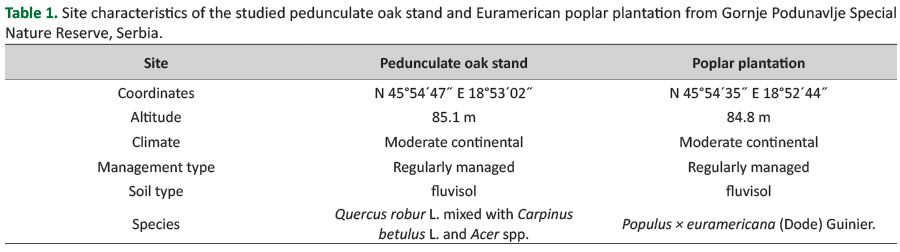
The sampling was conducted at two sites: 120-year-old pedunculate oak (Quercus robur L.) stand and 40-year-old plantation of Euramerican poplar (Populus × euramericana (Dode) Guinier) which is the most cultivated poplar in Serbia and represents an interspecies hybrid between Eastern cottonwood (Populus deltoides Bartr. Ex Marsh) and European black poplar (Populus nigra L.) (Đilas et al. 2023, Pilipović et al. 2023). Pedunculate oak trees were of good vitality and quality, while poplar plantation was degraded, consisted of overmatured Euramerican poplar trees and situated in an area which was planned for future restoration with autochthonous tree species. Both sites were located in the protected part of the alluvial plain of the Danube River, which is under regular management of Public Enterprise “Vojvodinašume” (Table 1). Habitat conditions are not optimal for either species due to limited groundwater supply. The poplar plantation was part of the chronosequence within the Horizon Superb project whose goal is to transform hybrid poplar plantation with low vitality into a vital forest where the dominant tree species would be the autochthonous pedunculate oak.
According to meteorological records obtained from the nearby station in Sombor over the period 1991–2020, the mean annual temperature in the area is 11.7 °C and the average annual rainfall is 636.0 mm. Examination of the average monthly sum of precipitation for this area showed that the months with the most and the least precipitations were June and March, respectively (RHMZ 2025).
Soil physical and chemical properties were determined in the surface layer of the soil (upper 30 cm). The following soil characteristics were analyzed: particle-size distribution (%) by the international B-pipette method with preparation in sodium pyrophosphate; determination of soil textural classes based on particle-size distribution using Atteberg classification; CaCO3 percentage (%) measured volumetrically by using Scheibler’s calcimeter; and pH in H2O determined with electrometric method using a combined electrode on Radiometer pH meter. Carbon and nitrogen content were determined with CHN element analyzer (Vario® EL III, Elementar Analysensysteme, Germany), while the content of humus was measured by the method of Turin. All analyses were performed in the Laboratory of Soil Science at the Institute of Lowland Forestry and Environment in Novi Sad, applying the methodology described by Galić et al. (2018).
At both sites, soil samples were taken on 9th November 2022 using a soil corer (total volume 274 ml and length 18 cm) at about 1 m from the target tree trunk. The total number of soil samples per site was eight and they were stored in a refrigerator at 4 °C. Before analyses each sample was submerged overnight in tap water to loosen the soil structure. All fine roots were carefully washed from the soil, placed in a petri dish above a grid and evenly distributed. One square color from the grid was randomly chosen and within this square 500 fine roots were counted. The total number of fine roots analyzed for both species was 4000. All obtained roots were divided into vital ECM root tips, or old, non-turgescent, and non-mycorrhizal roots using a dissecting stereomicroscope Olympus SZX10® (Olympus Corp., Tokyo, Japan) with magnifications 10-63× (light source: Olympus Highlight 3100, daylight filter). Vital ECM root tips were categorized into different morphotypes of ectomycorrhizas based on their morphological and anatomical characteristics using a dissecting microscope and a microscope Olympus BX53® (Olympus Corp., Tokyo, Japan) with magnifications 100-1000×.
Morphotypes of ectomycorrhizae were described following the methodology given by Agerer (1991) and Kraigher (1996). When it was possible, a fungal partner was determined by comparison of the obtained descriptions with published descriptions in Agerer (2008) or Agerer and Rambold (2025). Morphotypes of ectomycorrhizae were also classified into the exploration types (ETs) as proposed by Agerer (2001). All categories of fine root tips were quantified by counting under the dissecting microscope.
Molecular Identification of Ectomycorrhizal Fungi
Fungi from ECM root tips were identified with molecular tools based on PCR amplification of internal transcribed spacer (ITS) region of fungal nuclear rDNA. Genomic DNA was extracted from 2-5 ECM root tips of every ECM morphotype using a DNeasy® Plant Mini Kit (Qiagen, Hilden, Germany). Amplification reactions were performed using ITS 1F (Gardes and Bruns 1993) and ITS 4-primer pair (White et al. 1990) in Eppendorf Mastercycler (Eppendorf AG, Hamburg, Germany). Detailed procedure was given by Milović et al. (2023). Amplified DNA fragments were sent for sequencing to Macrogen Europe BV (Amsterdam, Netherlands) after purification with the QIAquick PCR® purification kit (Qiagen, Valencia, CA, USA). The ECM fungi were determined at the level of species, genus, or family by comparing the obtained sequences to those deposited in GenBank (NCBI 2021) and UNITE (Nilsson et al. 2018) database. The threshold value applied to differentiate the different operational taxonomic units (OTUs) based on ITS sequence similarity was 97%.
Data Analysis
Diversity indices were calculated as average value per sample and as total value per site (i.e., by pooling the ECM community data) following the formulas given by Atlas and Bartha (1981) and Taylor et al. (2000): (i) species richness index (d) = (S-1)/log10N, where S is the number of ECM fungal taxa and N is the number of all mycorrhizal tips; (ii) Shannon-Weaver’s diversity index (H) = C/N (N logN – Σ ni log ni), where C = 2.3, N is the number of all mycorrhizal tips and ni is the number of mycorrhizal tips of an individual ECM fungal taxon; (iii) Evenness (e) = H/logS, where H is the Shannon-Weaver’s diversity index and S is the number of ECM fungal taxa; (iv) Equitability (J) = H/Hmax, where H is the Shannon-Weaver’s diversity index and Hmax is the theoretical maximum H assuming that each ECM fungal taxon was equally abundant; (v) Berger-Parker’s evenness index (BP) = 1 - (Nmax/N), where Nmax is the number of mycorrhizal tips of the most frequent ECM fungal taxon and N is the number of all mycorrhizal tips.
In order to fit the normal distribution, percentage values were transformed by arcsine transformation using the Bliss formula (Snedecor and Cochran 1976). Tukey test was used to determine the significance of the differences between stands in an abundance of ETs. All statistical analyses were performed using the package STATISTICA® ver. 12 (StatSoft Inc., Tulsa, OK, USA).
RESULTS
The physico-chemical properties of the soil from pedunculate oak stand and Euramerican poplar plantation were in some traits quite similar: both soils have loam texture class, similar values for the content of CaCO3 and C/N ratio, and their pH is close to neutral. However, humus, carbon and nitrogen content were considerably higher in soil samples from pedunculate oak stand, suggesting higher soil fertility at this site (Table 2).

In the pedunculate oak stand and Euramerican poplar plantation, 17 and 15 ECM fungal taxa were recorded, respectively. The total number of analysed vital ECM roots was 1463, 810 on oak and 653 on poplar. The average number of ECM taxa per sample was 4.4 in the oak stand and 4.8 in the poplar plantation. The average value of species richness index was higher in Euramerican poplar plantation (1.98 vs. 1.7), while the Shannon-Weaver index was higher in the oak stand (1.24 vs. 1.01). Furthermore, evenness, equitability and Berger-Parker index on average were higher in the oak stand while in total these values were higher in the poplar plantation (Table 3).
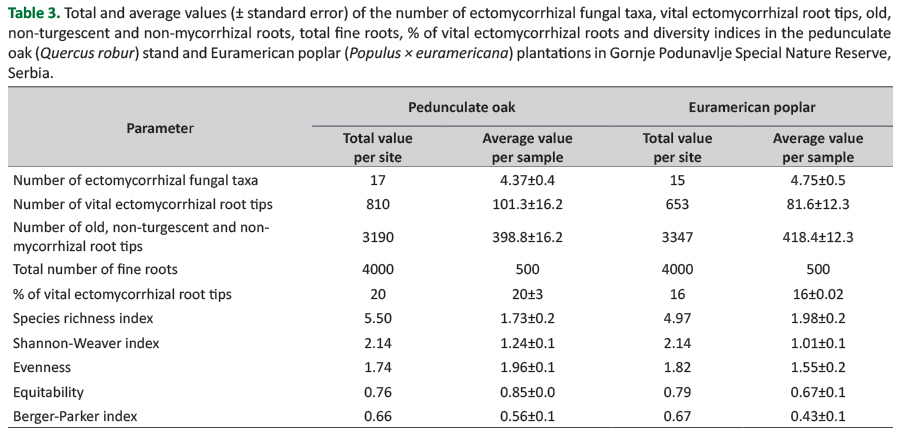
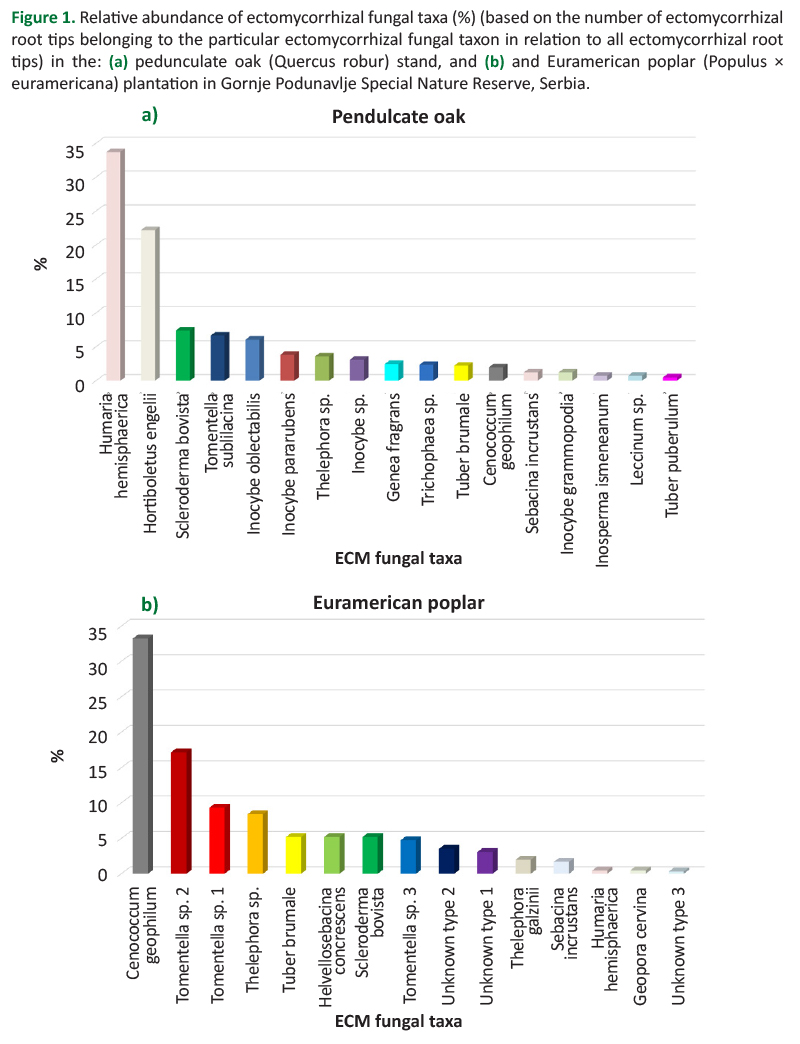
In Gornje Podunavlje Special Nature Reserve, 28 ECM fungal taxa were found in total. Sixteen ECM fungi were identified to the species level, eight to the genus level, and three ECM fungi remained unidentified. At both sites a few species dominated the ECM community, while others were rare. Only two ECM fungi colonized more than a half of all ECM roots at both sites. In the poplar plantation the most abundant were Cenococcum geophilum and Tomentella sp. 2, while in the pedunculate oak stand Humaria hemisphaerica and Hortiboletus engii colonized more than 55% of all roots (Figure 1, Supplement Table 1). ECM taxa H. hemisphaerica, Sebacina incrustans, Scleroderma bovista, Tuber brumale, and C. geophilum were common for both sites/species. In the pedunculate oak stand the most species rich genus was Inocybe with four ECM taxa, but in the Euramerican poplar plantation no members of this genus were observed. On the other hand, genus Tomentella was the richest in the poplar plantation with three taxa, but it had only one representative in the oak stand (Figure 1).
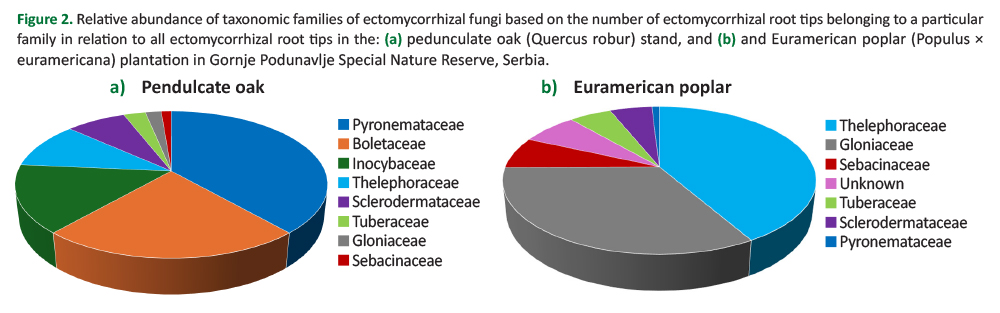
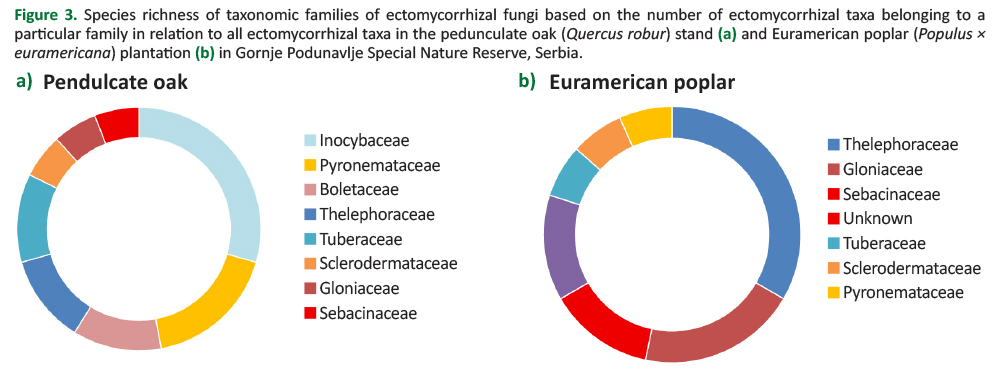
In the pedunculate oak stand, families Pyronemataceae, Boletaceae and Inocybaceae made association with 77% of all root tips, while in the Euramerican poplar plantation only two families (Thelephoraceae and Gloniaceae) colonized 75% of all ECM root tips (Figure 2). The most species-rich family in the pedunculate oak stand was Inocybaceae with 5 members, while in the Euramerican poplar plantation it was Thelephoraceae with also 5 members (Figure 3).
At both sites Basidiomycota fungal group had more ECM taxa and colonized more root tips compared to Ascomycota (Table 4). However, in the oak stand a bit more ECM taxa and ECM roots belonging to Ascomycota were observed compared to the poplar plantation.

In the pedunculate oak stand short distance ET dominated, followed by long-distance ET, while medium distance ET was the least abundant. On the other hand, in the poplar plantation the most abundant was short-distance ET, then medium-distance ET, while other ETs were relatively rare. Tukey’s test showed significantly higher abundance of long-distance ET in the oak stand than in the poplar plantation (Table 5).

DISCUSSION
In Gornje Podunavlje Special Nature Reserve situated in the northwestern part of Serbia, 17 ECM fungal taxa were found in the pedunculate oak stand. The obtained results are comparable with the results recorded in some other oak stands in Serbia. According to Milović et al. (2022), 18 ECM fungal taxa were recorded in the young pedunculate oak stand near Morović. In the mature pedunculate oak stand situated near the previous site, 21 ECM fungal taxa were observed (Milović et al. 2023), from which 19 in spring and 13 in autumn. Moreover, in two sessile oak stands from Fruška Gora National Park, 17 and 12 ECM taxa were found (Milović at al. 2021c).
In Europe, 12–14 ECM taxa were recorded in a 150-year-old pedunculate oak forest in north-eastern part of Poland (Olchowik et al. 2019), 18 ECM fungal taxa were recorded at the Taurus mountains in Central Germany (Schirkonyer et al. 2013), while 21 ECM taxa were determined on pedunculate and sessile oaks from Ireland (O’Hanlon and Harrington 2012). However, the average number of ECM fungi in oak plots across Europe during one season was 55, ranging from 24 fungal taxa in the Netherlands to 83 in Romania (Suz et al. 2014). In our study, the average number of ECM taxa per soil sample in the pedunculate oak stand was 4.4. Similar results were obtained in the mature pedunculate oak stand in Morović in spring (4.5) but in autumn this number was lower (2.9) (Milović et al. 2023). However, in young pedunculate oak higher average number of ECM taxa (5.6) was observed (Milović et al. 2022).
In our study, 15 ECM fungal taxa were observed in the Euramerican poplar plantation. The obtained results are comparable to the data recorded on poplars in other sites in Serbia. In an autochthonous white poplar (Populus alba L.) stand in the Kovilj-Petrovaradin marshes in Serbia, Katanić et al. (2015a) observed 20 ECM fungal taxa in total, from which 16 in spring and 15 in autumn. Furthermore, in a mature white poplar plantation during four consecutive seasons, 30 taxa of ECM fungi were recorded in total (Milović et al. 2021b). The highest number of ECM taxa was recorded in winter (22) followed by spring (19), while the lowest number was counted in autumn and summer (17). However, at pyrite tailings contaminated site near the Timok River Katanić et al. (2015b) recorded only 4 ECM taxa.
The results of our study are comparable to the results of Visser et al. (1998), who recorded 22 ECM types in a mixed forest dominated by American aspen (Populus tremuloides) in Canada, and Kaldorf et al. (2004), who observed 23 morphotypes in a five-year-old experimental aspen plantation in Germany. In addition, at three experimental sites with poplars in Poland, Karlinski et al. (2013) found in total 27 ECM fungal taxa. On the other hand, on an individual Populus tremula tree in an old-growth mixed forest from Estonia, Bahram et al. (2011) found 122 ECM fungal species. Jakucs (2002) recorded 70 ECM types at two sites with white poplars in Hungary during three years, while Krpata et al. (2008) found 54 ECM taxa in association with Populus tremula at a heavy metal polluted site in Austria. The average number of ECM taxa per soil sample in the poplar plantation was 4.8. In white poplar (Populus alba) from the Kovilj-Petrovaradin marshes, about 5 ECM taxa were observed per sample (Katanić et al. 2015a), while in the white poplar plantation this number ranged from 4 (in summer) to 5.8 (winter).
The percentage of vital ECM roots in the oak stand and poplar plantation was 20 and 16, respectively. Those values are comparable with the previous results obtained in Serbia in a young pedunculate oak stand (Milović et al. 2022) and a white poplar stand in Kovilj-Petrovaradin marshes (Katanić et al. 2015a).
If we compare diversity indices obtained in our study with previously published data from similar sites, we can state that they are comparable. Values of species richness index, Shannon Weaver index, evenness, equitability and Berger Parker index calculated for pedunculate oak stand from Gornje Podunavlje in autumn are similar to the same indices recorded in a mature pedunculate oak in spring (Milović et al. 2023) and a young pedunculate oak in summer (Milović et al. 2022), while values of species richness index and Shannon Weaver index were higher in comparison with sessile oak (Milović et al. 2021b). If we analyse diversity indices obtained for poplar plantation in Gornje Podunavlje and compare them to the ones from similar sites in Serbia, we can see that species richness index at our site was the highest. The value of Shannon Weaver index at our site was mostly similar to the one recorded in Kovilj-Petrovaradin marshes in spring (Katanić et al. 2015a), while evenness, equitability and Berger Parker index had values very similar to the ones obtained in a mature white poplar plantation in summer (Milović et al. 2021b).
In Gornje Podunavlje Special Nature Reserve, 17 ECM fungal taxa were found in the pedunculate oak stand where fungi Humaria hemisphaerica, Hortiboletus engii and Scleroderma bovista colonized the majority of fine roots. In the Euramerican poplar plantation, 15 taxa were recorded and among them the most abundant were Cenococcum geophilum, Tomentella sp. 2, Tomentella sp. 1 and Thelephora sp. ECM fungal community made of few abundant and many rare fungal taxa is a common phenomenon in other forest ecosystems (Suz et al. 2014, Katanić et al. 2015, Milović et al. 2021b, Milović et al. 2023). ECM fungi Humaria hemisphaerica, Sebacina incrustans, Scleroderma bovista, Tuber brumale, and C. geophilum were recorded on both species in our study, so they can be regarded as generalists.
In the pedunculate oak stand the most species-rich genus was Inocybe with four ECM taxa, while families Pyronemataceae, Boletaceae and Inocybaceae made association with most of the root tips. Studying ECM communities in temperate oak forests across nine European countries, Suz et al. (2014) discovered that overall, Lactarius quietus, C. geophilum and Russula ochroleuca were the most abundant taxa. Similarly, in two soil horizons of a temperate oak forest for 15 months, the most abundant species were: Lactarius quietus, Tomentella sublilacina, Cenococcum geophilum, and Russula sp. 1 (Courty et al. 2008). Previous work on the ECM community of a mature pedunculate oak stand in Serbia (Milović et al. 2023) also revealed Lactarius and Russula as a dominant fungal group. However, in our study, members of Russula and Lactarius genera were not observed in the pedunculate oak stand at all. This absence could be explained by differences in soil type, physico-chemical soil properties, previous land use and management practice between these sites.
In the poplar plantation in Gornje Podunavlje Special Nature Reserve the most abundant ECM taxa were: C. geophilum, Tomentella sp. 2 and Tomentella sp. 1, while genus Tomentella was the richest. Tomentella group was well represented in previous studies on white poplars in Serbia (Katanić et al. 2015a, Milović et al. 2021b), as well as genus Inocybe. However, no member of genus Inocybe was observed in the poplar plantation in our study. In the mature white poplar plantation from Sebia the most abundant ECM fungi were: Inocybe griseovelata, I. splendens, Tuber rufum, and Tomentella sp. 2, which together represented up to 50% of all ECM root tips (Milović et al. 2021b). In Kovilj Petrovaradin marsh the most abundant ECM fungi were: Entoloma sp., Tuber maculatum, C. geophilum, Tuber rufum and Peziza sp. (Katanić et al. 2015a).
At both analyzed sites, Basidiomycota dominated the ECM fungal community, which confirm numerous studies on poplars and oaks (Krpata et al. 2008, Milović et al. 2015a, Milović et al. 2021b, Milović et al. 2021c, Milović et al. 2022, Milović et al. 2023) where Basidiomycota was more abundant and had more members compared to Ascomycota group.
In our study, at both sites, short-distance ET dominated and made a large part of all ECM root tips. It was followed by long-distance ET in the pedunculate oak stand and by medium-distance smooth subtype ET in the Euramerican poplar plantation. Also, the difference in the abundance of long-distance ET between the pedunculate oak stand and the Euramerican poplar plantation was found. Similarly, in two white poplar stands in Serbia, the most abundant ET was short-distance ET. In the autochthonous white poplar stand whose soil was with 8% carbon, 0.3% nitrogen and C/N ratio 27.8, dominant short-distance ET was followed by medium-distance ET, while long-distance ET was not found (Katanić et al. 2015a). In the mature white poplar plantation, in soil with carbon content of 7.5%, nitrogen content of 0.13% and C/N content of 58.3, after dominant short distance ET, contanct ET was present to a lesser extent and long-distance ET was rare (Milović et al. 2021b). In the pedunculate oak stand from Morović, in soil with 3.1 % humus, 2.3% C, 0.13% N, and 18% C/N, Milović et al. (2023) noted that contact ET dominated the ECM community, while short-distance ET was less abundant and long-distance ET was rare. Investigating ECM diversity, community composition, and ETs in beech, pine, and spruce forests across Europe was noted that contact, and short-distance ETs had higher mean abundance compared to medium-distance and long-distance ETs (Rosinger et al. 2018).
ECM fungi have two main strategies for growth and nitrogen (N) acquisition. One focuses on the uptake of labile N forms (for example, amino acids, ammonium, and nitrate), and the other focuses on insoluble, complex organic resources of N (Hobbie and Agerer 2010). Mycorrhizas with contact, short- and medium-distance smooth ETs use labile, mainly inorganic nitrogen, while medium-distance fringe and mat, and long-distance ETs have access to insoluble and nonlabile substances due to hydrolytic exoenzymes. The latest ETs are rich in extraradical mycelium and have medium and long-distance hydrophobic rhizomorphs, but their demands for carbon are bigger (Hobbie and Agerer 2010, Lilleskova et al. 2011).
At both sites in Gornje Podunavlje Special Nature Reserve, the majority of ECM root tips belong to short-distance ET, which might indicate that soils contained sufficient labile and easily available N forms. The humus content in the Euramerican poplar plantation soil was lower, suggesting poorer conditions for the development of ECM fungi with long-distance ET, which was probably the cause of lower partition of long-distance ET at this site. On the other hand, higher abundance of long-distance ET recorded in the pedunculate oak stand is likely related to the higher humus content measured at this site. Therefore, ECM fungal community in the pedunculate oak stand consisted of ECM fungi with short-distance ET, which focuses on the use of labile N forms and long-distance ET which can degrade insoluble and non-labile substances from humus.
CONCLUSIONS
This is the first time that diversity of ectomycorrhizal fungi was studied in Gornje Podunavlje Special Nature Reserve in Serbia. In total 28 ECM fungal taxa were found, from which 17 ECM taxa in the pedunculate oak stand and 15 ECM fungal taxa in the Euramerican poplar plantation. The average value of species richness index was higher in the Euramerican poplar plantation, while Shannon-Weaver index, evenness, equitability and Berger-Parker index were higher in the pedunculate oak stand. At both sites a few species dominated the ECM community, while others were rare. The most abundant ECM taxa in the Euramerican poplar plantation were Cenococcum geophilum and Tomentella sp. 2, and in the pedunculate oak stand Humaria hemisphaerica and Hortiboletus engii. The most species-rich family in the pedunculate oak stand was Inocybaceae, while in the Euramerican poplar plantation it was Thelephoraceae. At both sites, the majority of ECM root tips belong to short-distance ET, which indicates that soils likely contain sufficient quantity of labile and easily available N forms. Higher abundance of long-distance ET recorded in the pedunculate oak stand is probably related to the higher humus content measured at this site.
Author Contributions
MM, ZG and SO conceived and designed the research, ZG and ZN carried out the field measurements, MM and ZG performed laboratory analysis, MM and BK processed the data and performed the statistical analysis, SO secured the research funding and supervised the research, MM, MD, SP, ZG and BK helped to draft the manuscript, MM, BK and ZG wrote the manuscript.
Funding
The study was financed by the Ministry of Science, Technological Development and Innovations of the Republic of Serbia within the project 451-03-136/2025-03/ 200197.
Conflicts of Interest
The authors declare no conflict of interest.
REFERENCES
Agerer R, 1991. Characterisation of ectomycorrhiza. In: Norris JR, Read DJ, Varma AK (eds) Techniques for the Study of Mycorrhiza. Methods in Microbiology 23. Academic Press, London, UK, 25-72.
Agerer R, 2001. Exploration types of ectomycorrhizae. A proposal to classify ECM mycelial systems according to their patterns of differentiation and putative ecological importance. Mycorrhiza 11: 107-114. https://doi.org/10.1007/s005720100108.
Agerer R, 2008. Colour Atlas of Ectomycorrhizae. 13th ed. Einhorn-Verlag, Schwäbisch Gmünd, Germany.
Agerer R, Danielson RM, Egli S, Ingleby K, Luoma D, Treu R, 2006. Descriptions of Ectomycorrhizae. 10th ed. Einhorn-Verlag, Schwäbisch Gmünd, Germany.
Agerer R, Rambold G, 2025. DEEMY - An Information System for Characterization and Determination of Ectomycorrhizae. Available online: www.deemy.de (15 August 2025).
Atlas R, Bartha R, 1981. Introduction to Microbiology. Addison-Wesley Publishing Company, Reading, UK, 242-244.
Bahram M, Põlme S, Kõljalg U, Tedersoo L, 2011. A single aspen (Populus tremula) tree individual may potentially harbor dozens of Cenococcum geophilum ITS genotypes and hundreds of species of ectomycorrhizal fungi. FEMS Microbiol Ecol 75: 313-320. https://doi.org/10.1111/j.1574-6941.2010.01000.x.
Bzdyk RM, Olchowik J, Studnicki M, Nowakowska JA, Oszako T, Urban A, Hilszczanska D, 2019. Ectomycorrhizal colonisation in declining oak stands on the Krotoszyn Plateau, Poland. Forests 10(1): 30. https://doi.org/10.3390/f10010030.
Courty PE, Franc A, Pierrat JC, Garbaye J, 2008. Temporal changes in the ectomycorrhizal community in two soil horizons of a temperate oak forest. Appl Environ Microbiol 74(18): 5792-5801. https://doi.org/10.1128/AEM.01592-08.
Đilas M, Orlović S, Marković M, Pap P, Kovačević B, Đorđević S, Zlatković M, 2023. Sušenje i umanjenje stabilnosti prestarelih stabala Populus × euramericana u urbanim sredinama: studija slučaja Železnički park, Novi Sad. Topola/Poplar 212: 43-66. https://doi.org/10.5937/topola2312043D. [in Serbian with English summary].
Frymark-Szymkowiak A, Kulczyk-Skrzeszewska M, Tyburska-Woś J, 2024. Seasonal Dynamics in Mycorrhizal Colonization and Fine Root Features of the White Poplar (Populus alba L.) in Natural Temperate Riverside Forests with Two Contrasting Soils. Forests 15(1): 64. https://doi.org/10.3390/f15010064.
Galić Z, Drekić M, Vasić V, Pekeč S, Kesić L, Novčić Z, 2018. Monitoring temperaturnih uslova u šumskim ekosistemima na nivou II praćenja prekograničnog zagađenja u delu Republike Srbije - AP Vojvodini. Topola/Poplar 201/202: 15-32. [in Serbian with English summary].
Gardes M, Bruns TD, 1993. ITS primers with enhanced specificity for basidiomycetes-application to the identification of mycorrhizae and rusts. Mol Ecol 2(2): 113-118. https://doi.org/10.1111/j.1365-294X.1993.tb00005.x.
Hobbie EA, Agerer R, 2010. Nitrogen isotopes in ectomycorrhizal sporocarps correspond to belowground exploration types. Plant Soil 327: 71-83. https://doi.org/10.1007/s11104-009-0032-z.
Jakucs E, 2002. Ectomycorrhizae of Populus alba L. in south Hungary. Phyton 42: 199-210.
Kaldorf M, Renker C, Fladung M, Buscot F, 2004. Characterization and spatial distribution of ectomycorrhizas colonizing aspen clones released in an experimental field. Mycorrhiza 14: 295-306. https://doi.org/10.1007/s00572-003-0266-1.
Karlinski L, Rudawska M, Leski T, 2013. The influence of host genotype and soil conditions on ectomycorrhizal community of poplar clones. Eur J Soil Biol 58: 51-58. https://doi.org/10.1016/j.ejsobi.2013.05.007.
Katanić M, Grebenc T, Orlović S, Matavuly M, Kovačević B, Bajc M, Kraigher H, 2015a. Ectomycorrhizal fungal community associated with autochthonous white poplar from Serbia. iForest 9: 330-336. https://doi.org/10.3832/ifor1370-008.
Katanić M, Orlović S, Grebenc T, Kovačević B, Kebert M, Matavulj M, Kraigher H, 2015b. Mycorrhizal fungal community of poplars growing on pyrite tailings contaminated site near the river Timok. SEEFOR 6: 53-63. https://doi.org/10.15177/seefor.14-18.
Kraigher H, 1996. Tipi mikorize: taksonomija, pomen, aplikacija. Zb Gozd Lesar 49: 33-66. [in Slovenian with English summary]
Kraigher H, Al Sayegh-Petkovšek S, 2011. Mycobioindication of stress in forest ecosystems. In: Rai M, Varma A (eds) Diversity and Biotechnology of Ectomycorrhizae. Soil Biology 25. Springer, Berlin, Heidelberg, Germany, 301-322. https://doi.org/10.1007/978-3-642-15196-5_13.
Krpata D, Peintner U, Langer I, Walter JF, Schweiger P, 2008. Ectomycorrhizal communities associated with Populus tremula growing on a heavy metal contaminated site. Mycol Res 112: 1069-1079. https://doi.org/10.1016/j.mycres.2008.02.004.
Lilleskov EA, Hobbie EA, Horton TR, 2011. Conservation of ectomycorrhizal fungi: exploring the linkages between functional and taxonomic responses to anthropogenic N deposition. Fungal Ecol 4: 174-183. https://doi.org/10.1016/j.funeco.2010.09.008.
Milović M, Kebert M, Orlović S, 2021a. How mycorrhizas can help forests to cope with ongoing climate change? Sumar List 145(5-6): 279-286. https://doi.org/10.31298/sl.145.5-6.7.
Milović M, Orlović S, Grebenc T, Bajc M, Kovačević B, Kraigher H, 2021b. Ectomycorrhizal fungal community in mature white poplar plantation. iForest 14: 540-547. https://doi.org/10.3832/ifor3827-014.
Milović M, Vasić V, Drekić M, Kovačević B, Pekeč S, Galić Z, Orlović S, 2021c. Diversity of ectomycorrhizal fungi associated with Quercus petraea in the National Park Fruška gora in the Republic of Serbia. Sumar List 145(11-12): 547-556. https://doi.org/10.31298/sl.145.11-12.4.
Milović M, Kovačević B, Pekeč S, Pilipović A, Kesić L, Gavranović Markić A, Orlović S, 2022. Diversity of ectomycorrhizal fungi in young pedunculate oak stand from Morović, Serbia. SEEFOR 13(1): 19-25. https://doi.org/10.15177/seefor.22-02.
Milović M, Kovačević B, Drekić M, Pilipović A, Pekeč S, Kesić L, Dilas M, Karaklić V, Galić Z, 2023. Ectomycorrhizal diversity in a mature pedunculate oak stand near Morović, Serbia. iForest 16: 345-351. https://doi.org/10.3832/ifor4362-016.
NCBI GenBank, 2025. GenBank. Available online: http://www.ncbi.nlm.nih.gov/genbank/index.html
(accessed in 2025).
Nilsson RH, Larsson KH, Taylor AFS, Bengtsson-Palme J, Jeppesen TS, Schigel D, Kennedy P, Picard K, Glöckner FO, Tedersoo L, Saar I, Kõljalg U, Abarenkov K, 2018. The UNITE database for molecular identification of fungi: handling dark taxa and parallel taxonomic classifications. Nucleic Acids Res 47(D1): D259-D264. https://doi.org/10.1093/nar/gky1022.
O’Hanlon R, Harrington TJ, 2012. Similar taxonomic richness but different communities of ectomycorrhizas in native forests and non-native plantation forests. Mycorrhiza 22(5): 371-382. https://doi.org/10.1007/s00572-011-0412-0.
Olchowik J, Hilszczańska D, Bzdyk RM, Studnicki M, Malewski T, Borowski Z, 2019. Effect of deadwood on ectomycorrhizal colonisation of old-growth oak forests. Forests 10(6): 480. https://doi.org/10.3390/f10060480.
Pilipović A, Orlović S, Kovačević B, Poljaković Pajnik L, Popović J, Raković D, Jovanović A, 2023. Produkcija biomase klonova evroameričke topole (Populus × euramericana (Dode) Guinier) u zasadima kratke ophodnje sa različitim razmacima sadnje. Topola/Poplar 212: 33-41. https://doi.org/10.5937/topola2312033P. [in Serbian with English summary].
RHMZ, 2025. Republički hidrometeorološki zavod. Available online: http://www.hidmet.gov.rs/ (24 May 2025).
Rosinger C, Sandén H, Matthews B, Mayer M, Godbold DL, 2018. Patterns in ectomycorrhizal diversity, community composition, and exploration types in European beech, pine, and spruce forests. Forests 9(8): 445. https://doi.org/10.3390/f9080445.
Schirkonyer U, Bauer C, Rothe G, 2013. Ectomycorrhizal diversity at five different tree species in forests of the Taunus Mountains in Central Germany. Open J Ecol 3(1): 66-81. https://doi.org/10.4236/oje.2013.31009.
Selosse MA, Richard F, He X, Simard SW, 2006. Mycorrhizal networks: les liaisons dangereuses? Trends Ecol Evol 21(11): 621-628. https://doi.org/10.1016/j.tree.2006.07.003.
Smith SE, Read DJ, 2008. Mycorrhizal Symbiosis. 3rd ed. Elsevier Academic Press, London, UK, 787 p.
Snedecor GW, Cochran WG, 1976. Statistical Methods. Iowa State University Press, Ames, IA, USA, 524 p.
Stojanović DB, Orlović S, Zlatković M, Kostić S, Vasić V, Miletić B, Kesić L, Matović B, Božanić D, Pavlović L, Milović M, Pekeč S, Đurđević V, 2021b. Climate change within Serbian forests: current state and future perspectives. Topola/Poplar 208: 39-56. https://doi.org/10.5937/topola2108039S.
Stojanović V, Mijatov M, Dunjić J, Lazić L, Dragin A, Milić D, Obradović S, 2021a. Ecotourism impact assessment on environment in protected areas of Serbia: a case study of Gornje Podunavlje Special Nature Reserve. Geogr Pannonica 25: 157-167. https://doi.org/10.5937/gp25-32288.
Suz LM, Barsoum N, Benham S, Dietrich HP, Fetzer KD, Fischer R, García P, Gehrman J, Kristöfel F, Manninger M, Neagu S, Nicolas M, Oldenburger J, Raspe S, Sánchez G, Schröck HW, Schubert A, Verheyen K, Verstraeten A, Bidartondo MI, 2014. Environmental drivers of ectomycorrhizal communities in Europe’s temperate oak forests. Mol Ecol 23(22): 5628-5644. https://doi.org/10.1111/mec.12947.
Szuba A, 2015. Ectomycorrhiza of Populus. For Ecol Manag 347: 156-169. https://doi.org/10.1016/j.foreco.2015.03.012.
Taylor AFS, Martin F, Read DJ, 2000. Fungal diversity in ectomycorrhizal communities of Norway spruce (Picea abies (L.) Karst.) and beech (Fagus sylvatica L.) along north-south transects in Europe. In: Schulze ED (ed) Carbon and Nitrogen Cycling in European Forest Ecosystems. Ecological Studies 142. Springer-Verlag, Berlin, Heidelberg, Germany, 343-365.
UNESCO, 2025. Man and the Biosphere Programme (MAB): Mura-Drava-Danube. Available online: https://www.unesco.org/en/mab/mura-drava-danube (28 August 2025).
Visser S, Maynard D, Danielson RM, 1998. Response of ecto- and arbuscular fungi to clearcutting and the application of chipped aspen wood in a mixedwood site in Alberta, Canada. Appl Soil Ecol 7: 257-269. https://doi.org/10.1016/S0929-1393(97)00060-7.
White TJ, Bruns T, Lee S, Taylor J, 1990. Amplification and direct sequencing of fungal ribosomal RNA genes for phylogenetics. In: Innis MA, Gelfand DH, Sninsky JJ, White TJ (eds) PCR Protocols: A Guide to Methods and Applications. Academic Press, San Diego, USA, 315-322.
© 2026 by the author(s). License: Croatian Forest Research Institute. This article is an open access article distributed under the terms and conditions of the Creative Commons Attribution 4.0 International License (CC BY 4.0).