


SEEFOR 17(1): 26016
Article ID: 26016
DOI: https://doi.org/10.15177/seefor.26-016
ORIGINAL SCIENTIFIC PAPER
Physical Properties and Germination Capacity of Black Alder Seeds: Informing Reforestation Efforts for a Threatened Population near Lake Prespa, North Macedonia
Anastazija Dimitrova1,*, Svetlana Pejovikj2, Ognen Onchevski1, Ivan Minchev1, Dana Dina Kolevska1
Addresses:
(1) Ss. Cyril and Methodius University in Skopje, Hans Em Faculty of Forest Sciences, Landscape Architecture and Environmental Engineering, str. 16 Makedonska Brigada 1, MKD-1000 Skopje, North Macedonia;
(2) Macedonian Ecological Society, str. Todor Skalovski 9A, MKD-1000 Skopje, North Macedonia
Citation: Citation: Dimitrova A, Pejovikj S, Onchevski O, Minchev I, Kolevska DD, 2026. Physical Properties and Germination Capacity of Black Alder Seeds: Informing Reforestation Efforts for a Threatened Population near Lake Prespa, North Macedonia. South-east Eur for 17(1): 26016. https://doi.org/10.15177/seefor.26-016.
Received: 12 Dec 2025; Revised: 14 Apr 2026; Accepted: 29 Apr 2026; Published online: 26 Jun 2026
Cited by: Google Scholar
Abstract
Widely spread across Europe, black alder (Alnus glutinosa (L.) Gaertn.) is a keystone species in riparian ecosystems. In North Macedonia, the black alder population present in the proximity of Lake Prespa is under severe threat due to the combined impact of anthropogenic factors, climate change, and the age and state of the mature trees. Recent reforestation activities where locally produced seedlings were planted have been conducted; however, significant knowledge gaps regarding the species biology and current state of the reproductive material may decrease the output, i.e., seedling survival. Therefore, in the present study, we analyse the physical and physiological properties of seed lots collected in 2023 and 2024. Furthermore, we also analyse the results from five pre-sowing treatments (cold stratification, ethanol treatment, hydrogen peroxide treatment, water soak, and hydrothermal treatment) selected based on the A. glutinosa seed properties. The results indicate a lower viability in the seed lot from 2023, which could be due to the longer storage as well as a potentially low-seed year. The lower viability is reflected in the lower thousand seeds weight (1.165 g in 2023, 1.725 g in 2024), lower germination capacity (20.7% in 2023, 33.4% in 2024), lower germination energy (19.9% in 2023, 31.9% in 2024), and lower viability (18.5% of healthy seeds in 2023, 36.24% in 2024). The comparison between the pre-sowing treatments showed cold stratification as superior to all other treatments, for the seeds lots from both years. Furthermore, with ethanol treatment and water soak, no seeds germinated, indicating a deep dormancy of black alder seeds that needs to be overcome by more intensive physical and/or chemical stimulation. To the best of our knowledge, this is the first study conducted on black alder seeds’ germination capacity in North Macedonia. As such, it provides valuable insight into the overall state of the reproductive material as well as practical data on the pre-sowing treatments’ effect. With conservation in mind, future research analysing the results of direct sowing as compared to planting, as well as the improvement of nursery production with higher seeding rates (due to the natural low viability of black alder seeds) and the implementation of arbuscular ectomycorrhiza could be of interest.
Keywords: riparian; forest; nursery; plant production; seed characteristics; reforestation; germination
INTRODUCTION
The combined effects of climate change and land-use intensification pose a severe threat for numerous tree species worldwide (Iralu et al. 2019). Reforestation (or revegetation) is a commonly used active restoration approach that relies on direct seeding on field or planting nursery-grown plant material (saplings) of the target species (Greet et al. 2020). Both methods have positive and negative sides. Direct seeding is less costly but constricted by seed predation, germination, and early seedling survival. On the other hand, while it surpasses these obstacles, the planting of saplings also requires more inputs in terms of facilities, labour, and management (Moore et al. 2011, Grossnickle and Ivetić 2017, Willoughby et al. 2019). Since seeds are required for the propagation of most tree species, seed germination studies can be an important tool for species conservation, providing insight into the species’ plasticity in situ and the requirements for germplasm conservation ex situ (Iralu et al. 2019). A combined effect of numerous factors conditions the germination outcome, but most relevant are seed coat properties and general morphological seed parameters as internal factors, and temperature, humidity, and water availability as external factors (Kumar et al. 2024). Thus, pre-sowing (or germination) treatments, during which the seed coat can be impacted and ecological factors manipulated, have an important role for the germination success (Chowdhury et al. 2024). Treatment selection is based on the species biology, and commonly involves soaking, stratification, scarification, manipulation of humidity, light, temperature and growing media, and application of plant growth regulators, i.e., plant hormones such as abscisic acid, gibberellins, auxins, etc. (Iralu et al. 2019). Germination success is also impacted by the genetic predispositions and the continuous environmental conditions that preceded the seed production period which need to be considered, especially during the mother plant selection and seed collection phase.
Commonly present in riparian ecosystems, black alder (Alnus glutinosa (L.) Gaertn.) is a widespread tree species across Europe (Verbylaitė et al. 2023). It has been found to be of particular value since it can aid water purification from excessive nutrient concentration, provide soil stabilization and erosion control as a pioneer species, has a nitrogen-fixing ability, and can serve as food sources for wildlife during the winter months (Peterjohn and Correll 1984, Mingeot et al. 2016, Willoughby et al. 2019, Sanglyne et al. 2021). The seeds of such riparian plant species are commonly dispersed via anemochory (by wind), hydrochory (by water), and zoochory (by animals) (Fraaije et al. 2017). Since the dispersal mechanisms are crucial for the species survival strategy, and as such have co-evolved with the preferred environmental conditions of the species, they have also impacted the morphophysiological seed characteristics (Levin and Muller-Landau 2000). Please change this sentence to:
In the case of A. glutinosa, the seeds -actually winded fruits or achenes containing a single seed without endosperm and surrounded by a pericarp (de Atrip et al. 2007) - are relatively small (2 - 3.5 mm), with low seed specific weight and high buoyancy due to the cork-like seed coat and a waxy surface. Seed production begins when the individuals are 20–30 years old, and every two to three years high seed production occurs, although a certain percentage of viable seeds can be present even in the low seeding years (Göktürk and Güner 2024). Black alder seeds exhibit an orthodox storage behaviour, meaning that when stored in proper conditions (low moisture content and low temperature), they can maintain their viability (Koutsovoulou et al. 2025). Storage conditions and duration can impact germination, and in the case of black alder, studies have shown that seed storage in proper conditions enables the conservation of the seed quality (Chmielarz 2010, Tylkowski 2014, Koutsovoulou et al. 2025)
In North Macedonia, in the Prespa region located in the south-west part of the country, A. glutinosa dominates several types of alluvial riparian forests, i.e., Alno-Padion, Alnion incanae, and Salicion albae (Fotiadis et al. 2018). However, these stands, fragmented and consisting mainly of older individuals, are further threatened by the expansion of orchards in the area, the increasing population of the invasive alien species Amorpha fruticosa L., and climate change (Fotiadis et al. 2018). Since this is a priority habitat type (Council Directive 92/43/EEC 1992, Fotiadis et al. 2018), attempts for its conservation also include reforestation efforts since the aforementioned threats have also diminished the natural regeneration potential.
Since an important aspect of species conservation is identifying and providing optimal conditions for seed and seedling survival and establishment (Ehardt-Kistenmacher et al. 2019), practical knowledge regarding seed quality and germination is extremely relevant for improving plant production and the success of the seedlings after their outplanting (Chowdhury et al. 2024). With species such as A. glutinosa, whose seeds undergo natural cold stratification in the soil during the winter months, this could be of even higher relevance considering the climate change extremes during which temperatures might fluctuate differently (Twardosz et al. 2021). Therefore, the present study aimed to compare the seed viability and germination capacity of two consecutive sampling years and test how five different pre-sowing treatments impact seeds from A. glutinosa. We hypothesized that:
- the seed quality, reflected in the physical and
physiological seed properties will not differ between the seeds collected in 2023 and the seeds collected in 2024; - cold stratification, as a pre-sowing treatment, would be most appropriate for black alder seeds.
MATERIALS AND METHODS
Study Area and Seed Collection
The study was conducted in the Prespa region, in the south-west part of North Macedonia, characterized by the presence of Lake Prespa (Figure 1). The infructescences from A. glutinosa (cone-like strobiles) were manually gathered from five known mother trees which had been selected due to desirable phenotypic characteristics: overall tree vigour, tree health, vital branches with leaves, relatively rich crowns, absence of mechanical damage, and observed reproductive capacity as indicated by strobile formation. Notably, they were all located in the proximity to rivers. The infructescences were then processed by manual pressing and sieving until the seeds (samaras) were extracted. Both the seeds gathered in October 2023 and October 2024 were conserved in paper bags at 4°C and estimated relative humidity of around 20%, until the seed tests were performed in January 2025. A total of 0.5 kg and 0.5 kg of seeds were gathered in 2023 and 2024, respectively.

Seed Properties Analysis
The two seed lots, collected in 2023 and 2024, were processed in the same manner but analysed separately for the purpose of the study. From each seed lot, a manually obtained primary sample, which served as a submitted sample, was randomly obtained, in the quantity of 10.99 g (2023) and 12.04 g (2024). In the laboratory, these submitted samples were used as working samples since their weight corresponded with the minimal submitted sample rules indicated by ISTA (ISTA 2025). From each working sample, by randomly taking ten separate scoops with continuous mixing in between, smaller working samples were formed for further analysis. The samples were weighed and cleaned by sieves and the manual removal of non-seed material. This material was first used to measure seed purity (SP) as a physical property used to assess seed quality by comparison of seed weight before and after cleaning calculated as:
 (1)
(1)
where, Wps is the weight of the cleaned sample, and TW is the total weight of the working sample (Rajendra Prasad 2023, ISTA 2026a).
Then, from these samples, 24 × 100 smaller samples were separated and weighted for both sampling years (2023 and 2024). Each of them was weighted and used to measure the thousand seed weight (TSW) as a physical property correlated with germination vigour and field performance, and calculated as:
 (2)
(2)
where X1, X2, and Xn indicate the individual weight of working samples of 100 seeds, and n is the number of working samples used (ISTA 2026b).
Regarding the physiological seed properties, we calculated the standard germination capacity (GC), germination energy (GE), and practical seed value (PCV). GC is used for measuring the maximum germination capacity and it is executed by placing four samples of 100 seeds under optimal conditions after exposure to pre-germination treatments. In the present study, this was achieved by placing the seeds on constantly moistened gauze with an adapted growing tray, and maintaining them in constant conditions at room temperature (22°C ± 2°C) and high humidity (80%–90%) (Qi et al. 2019). All seeds were observed every 2–3 days, over the period of 28 days, and, if present, germinated seeds were counted and removed from the germination tray. The GC was calculated as:
 (3)
(3)
where Ngs is the number of germinated seeds, and TNs is the total number of tested seeds (Rajendra Prasad 2023).
GE was calculated to evaluate seed vigour, i.e., the speed and uniformity of germination during the first seven days (after transferring to the germination tray) calculated as:
 (4)
(4)
where Ne is the number of germinated seeds in the first 7 days, and TNs is the total number of tested seeds (Si et al. 2018).
PCV is a derived metric calculated based on seed purity and standard germination capacity used to determine the actual planting value of a seed lot calculated as:
 (5)
(5)
where SP is seed purity, and GC is germination capacity.
Furthermore, a seed viability test (VT) was performed to evaluate seed viability and vigour, and to examine the internal structures (embryo, endosperm, cotyledons) without full germination. In the case of A. glutinosa, an adapted VT was performed by manually cutting 400 seeds from each sampling year, longitudinally, and noting the state of the seeds (Frischie et al. 2020). The cut seeds were classified in one of the four categories – healthy seeds, empty seeds, rotten seeds, and suspicious seeds. After cutting, the VT was calculated as:
 (6)
(6)
where Nhs is the number of healthy seeds, and TS is the total number of cut seeds.
Pre-sowing Treatments
Based on the literature revision and the known seed properties of A. glutinosa, five pre-sowing seed treatments were selected for the purpose of the experiment. A total of 400 seeds (4 × 100) were used for each of the treatments, as described in detail in Table 1.
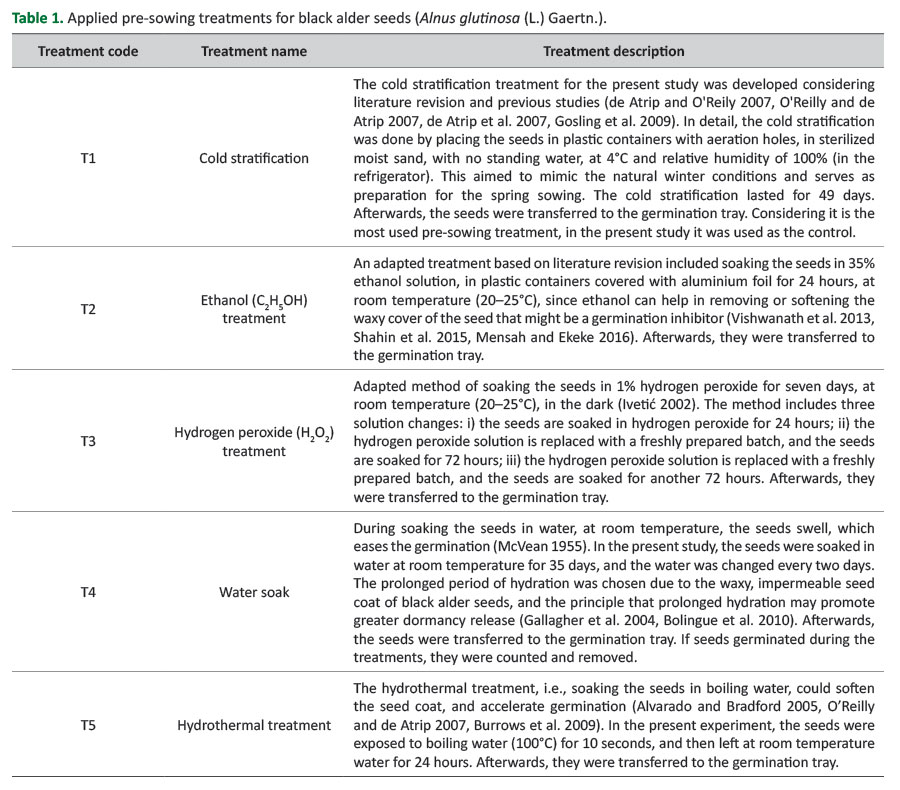 Table 1.Applied pre-sowing treatments for black alder seeds (Alnus glutinosa (L.) Gaertn.).
Statistical Analysis
For the physical properties (SP and TSW) only descriptive analysis of the relative differences were performed, since single measurements were obtained per year. For the physiological properties (GC, GE, and PCV), the treatment effects were assessed with a two-way ANOVA with interaction terms (Treatment × Year) for each response variable. When significant effects were detected, Tukey's HSD tests for pairwise comparisons was used. For GE, the data contained zero-inflated values for treatments T3 and T5; therefore, a Kruskal-Wallis non-parametric test was applied instead of ANOVA. For VT, the percentage of each seed category (healthy, empty, rotten, and suspicious) was calculated relative to the total number of cut seeds per year. To assess the seed viability distribution between the two years, a Fisher’s exact test was applied, and a two-sample proportion test was used to compare the prevalence of healthy seeds between the years. Statistical significance was assessed at p < 0.05. All analyses were conducted in R version 4.3.0 (R Core Team 2021).
RESULTS
The studied samples from both sampling years corresponded with the indicated criteria in the International Seed Testing Association (ISTA) guidelines for A. glutinosa, i.e., the maximum weight of lot (in kg) was 1000 kg and the minimum submitted sample (in g) was 8 g (ISTA 2025).
Physical Seed Properties
The results from the physical seed properties indicate an overall increase as all parameters exhibited higher values in the second sampling year. Both SP and TSW were higher in 2024 (Table 2, Figure 2a, 2b).


Physiological Seed Properties
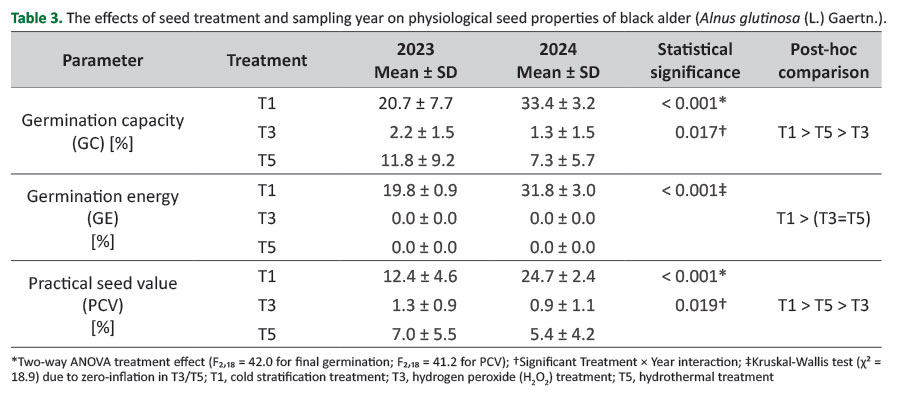
The analysis excluded the seeds subjected to the ethanol treatment (T2) and the water soak treatment (T4). In the case of T2, the seeds from both collecting years were excluded from the analysis since no germination took place. In the case of T4, for samples from 2023, 19 seeds germinated during the water soaking stage, while none germinated once transferred to the germination tray; and for samples from 2024, no seeds germinated during the water soaking stage, and only one seed germination on the germination tray. For the other three treatments (T1, T3, and T5), the two-way ANOVA revealed highly significant treatment effects on all measured parameters (p < 0.001) (Table 3). Regarding GC, T1 resulted in superior performance (27.1% mean germination) compared to T5 (9.5%) and T3 (1.8%), with all pairwise differences being statistically significant (Tukey's HSD, p < 0.05). This pattern was further observed in the GE comparison, as T1 exhibited substantial early germination (19.9% in 2023; 31.9% in 2024) while T3 and T5 had complete germination absence at the 7-day evaluation point. Consequently, PCV mirrored these trends, with T1 producing significantly higher values (12.4% in 2023, 24.7% in 2024) than other two treatments (p < 0.001) (Table 3). A significant Treatment × Year interaction indicated that treatment effects varied between years. Notably, with the samples from 2024, T1 showed a germination increase of 12.7% and PCV by 12.3%, compared to 2023 values, while T3 and T5 remained consistently low for both sampling years. In summary, the most substantial treatment differences were observed in the 2024 PCV measurements, as T1 (24.7%) exceeded T3 (0.9%) by 23.8 percentage points, demonstrating the combined impact of treatment efficacy and seed purity on overall seed quality (Table 3, Figure 2c, 2d, 2e).
Regarding the VT, the proportion of healthy seeds increased from 18.5% in 2023 to 36.25% in 2024, while the empty seeds decreased from 81.5% to 56.25% (Table 4). No rotten or suspicious seeds were recorded in either year. Fisher’s exact test indicated a significant difference in the distribution of seed viability categories between the two years. The two-sample proportion test, which compared the number of healthy seeds, also showed a significant increase, from 11.44% in 2023 to 24.06% in 2024, with a 95% confidence interval.

DISCUSSION
The present study provides an investigation of physical characteristics and germination analysis on A. glutinosa seeds sampled in two consecutive years (2023 and 2024) in a riparian ecosystem in the Prespa region (in the south-west of North Macedonia) subjected to five different pre-sowing treatments. The results show a difference of the seed properties between the two sampling years, i.e., higher weight and germination rate in the 2024 seed batch. Therefore, we have to reject the first hypothesis as the seeds collected in 2023 show lower quality than the seeds collected in 2024. While it is expected for seeds to lose moisture (i.e., weight) overtime, conservation at lower temperatures has shown to be able to preserve viability in A. glutinosa seeds (Hall and Nyong’o 1989, Harrington et al. 2008, Koutsovoulou et al. 2025). However, other studies have shown that A. glutinosa seeds stored for two years at 4°C also report a lower germination rate with cold-stratification as a pre-sowing treatment in the experimental design, or potentially, an insufficient sowing rate (Willoughby et al. 2019). Regardless of the sampling year, we have observed an overall low seed viability and germination capacity, which would further reflect as a low number of seedlings (produced in nursery or obtained by direct seeding in open field). Although species with smaller and lighter seeds usually produce them in higher numbers than those with larger and heavier seeds (Leyer and Pross 2009), the germination rates of A. glutinosa are known to be low (de Atrip et al. 2007, de Atrip and O’Reilly 2007, Morales et al. 2012). Self-fertilization can also contribute to seeds with aborted ovules (empty seeds) and such occurrences have been reported in A. glutinosa and other alder species (Harrington et al. 2008), which could also explain the overall large number of empty seeds in both sampling years in our case. A high proportion of empty seeds (> 60%) has also been noted in another study in neighbouring Greece (Koutsovoulou et al. 2025). Numerous other factors can contribute to the low seed viability (Sanglyne et al. 2021) and they are not mutually exclusive, but rather act conjointly. The reduced capacity of seed production could be due to self-fertilization or senescence. Further phenological observations focusing on pollen production and fruit formation need to be conducted for concrete conclusions. However, frequent external disturbances can reduce the seed regeneration capacity in woody plants (Ehardt-Kistenmacher et al. 2019). Climate change, i.e., reduced water availability and prolonged periods of high temperature in crucial parts of the year when the seeds are forming and maturing are a probable scenario, especially since A. glutinosa has a higher need for moisture and abrupt precipitation changes are likely to impact seed characteristics (Göktürk and Güner 2024).
The low seed viability is further reflected in the results from the pre-sowing treatments, although they were selected to address seed dormancy, notably present in A. glutinosa seeds. Most common inhibitors cause physical dormancy, where the seed coat impermeability can keep the seeds dormant from few months to up to 5 years (Iralu et al. 2019). Indeed, the complete germination absence with ethanol and water soak treatments suggests that dormancy breaking for A. glutinosa required physical or chemical stimulation, e.g., complementary treatment combinations such as scarification and soaking in water or specific environmental cues (i.e., temperature and humidity fluctuations) for breaking the dormancy. Seed dormancy and germination characteristics may be due to niche adaptation of a species for securing regeneration (Stromberg et al. 2011, Kanazashi et al. 2015). Considering the ecological niche of riparian species, this is highly likely for A. glutinosa and corresponds with the pronounced superiority of the cold stratification across all parameters since the treatment effectively overcame seed dormancy barriers without causing seed damage, likely through enhanced imbibition and the activation of metabolic processes. These results confirm our second hypothesis since the cold stratification showed to be the most effective pre-sowing treatment. The hydrothermal treatment was proven the next most effective after the cold stratification, although not as significantly more as the hydrogen treatment. The hydrothermal treatment involves exposing the seeds to temperature extremes and the hydrogen treatment involves soaking for an extended period in dark conditions. Due to the seed characteristics, future research could explore if combined treatments could be used to provide both physical and chemical stimulation for breaking the dormancy. Dormant seeds can cycle between sensitive (latent soft seeds) or insensitive (hard seeds) stages to dormancy breaking treatments (Taylor 2005). Thus, considering that cold stratification requires more time and in order to ensure higher germination percentages of the viable seeds, further studies that combine it with hydrothermal treatment may be of value. As noted in another study, there is a difference if A. glutinosa seeds have been sown in the autumn directly in the soil (mimicking the time of natural seed fall and exposure to the period of moist winter chilling and spring emergence when spring temperatures rise sufficiently) or if they have been artificially pre-chilled and sown in the spring (which notably provides for later emergence and potentially negative impact of dry and hot conditions during April and May) (Willoughby et al. 2019). Since seed types such as A. glutinosa are less likely to succumb to predation, autumn sowing might be better but in the case of spring sowing, pre-chilling of at least 20% of the total seed batch is recommended (Willoughby et al. 2019). Indeed, since temperature has been identified as the most crucial factor for germination, seedbeds in nurseries often provide a suboptimal temperature, especially for the spring sowing since temperature is more difficult to manage than moisture (de Atrip et al. 2007).
Although A. glutinosa has a wide natural distribution, from the Mediterranean to mid Scandinavia, it is more adapted to moderate and cooler climate with continuous water availability, which might be an issue if the seasonal characteristics change (i.e., warmer autumns, shorter winters, and dried springs and summers) (Gosling et al. 2009, Nave et al. 2021). Furthermore, small population of mature individuals and continuously reduced seed production can be a characteristic of a threatened species (Iralu et al. 2019). Considering this, to ensure the conservation of A. glutinosa in the Prespa region, several restoration activities could be attempted. Considering the high benefit from cold stratification, a potential strategy could be direct seeding in the autumn, directly after collection. In this case, the highest risk would be from low temperatures in the spring, but higher seeding rates that follow recommendations from a seed quality analysis could be a potential mitigation strategy. While it has been noted that an optimal germination temperature for A. glutinosa and green alder (Alnus viridis subsp. crispa (Aiton) Turrill) is between 22 and 26°C, these results are based on studies conducted in the United Kingdom and northwestern Ontario where the climatic conditions differ (Farmer Jr. et al. 1985, de Atrip et al. 2007). In the Mediterranean climate, germination occurs as soon as proper moisture is available in the soils, which is why climate change may impact the outcome from known pre-sowing treatments more severely due to reduced rainfall and higher temperatures (Luna et al. 2023). Therefore, it would be of value to monitor how the local climatic conditions impact the on-field germination as well as potential adaptations of the nursery practices.
Additional threats to the populations of A. glutinosa in Prespa also need to be anticipated based on relevant research outcomes from other countries. For instance, in Central Europe the host-specific pathogen Phytophtora alni species complex is widely present and adapted for water survival (Nave et al. 2021). Since many years can pass from the first symptoms onset (bleeding cankers), and anthropogenic activity is an important transmission factor (22), regional studies in Prespa would be of interest. The risk of invasive species in riparian forests should also be considered. In a study in native floodplain forests in Central Spain that have undergone significant degradation, the exotic Ailanthus altissima (Mill.) Swingle, Ulmus pumila L., and Robinia pseudoacacia L. have exhibited high germination rates, long-lasting seed banks and the capacity for successful germination under heterogeneous conditions that suppress the high proportion of empty seeds and low germinability in the native Ulmus minor Mill. and Fraxinus angustifolia Vahl (Cabra-Rivas and Castro-Díez 2016). Considering the invasive species Amorpha fruticosa has been noted in the study region (Fotiadis et al. 2018), monitoring of its expansion and proper measures for both in situ and ex situ conservation of A. glutinosa is needed. In the nurseries, cold stratification seems to be the most suitable pre-sowing treatment, and it should be adopted as a regular practice. However, the seeding rate needs to be adapted based on the results from germination rates, as we observe a variability between the two sampling years. Some alternative treatments have been proven effective, e.g., priming seeds of Caucasian alder (Alnus subcordata C.A.Mey.) with multi-walled carbon nanotubes which improved the germination under drought stress (Rahimi et al. 2016), or the use of symbiotic relationships between A. glutinosa roots with arbuscular ectomycorrhiza and nitrogen fixing bacteria from the genus Frankia (Wheeler et al. 1991, Ehardt-Kistenmacher et al. 2019). However, such practices are often costly and require a specific infrastructure, which might be a major obstacle. Further nursery and field-based studies exploring this interaction might also support the seeding establishment
CONCLUSIONS
Riparian ecosystems provide numerous benefits and, as such, are of a particular conservation interest. In the Prespa region, in south-west North Macedonia, black alder, one of the main species in the riparian ecosystem, is under threat due to combined effect of naturally occurring and anthropogenic factors. Reforestation efforts currently rely on seedling production from locally collected seeds. However, no information is available on the state of the mother trees, and thus the seed quality. Furthermore, since black alder seeds require pre-sowing treatment, it is of great practical value to understand how different treatments impact the seeds and subsequently select the most suitable one. The present study addresses both issues, by analysing seeds collected in two consecutive years (2023 and 2024) and a comparative analysis of five pre-sowing treatments, selected based on the black alder seeds’ properties. The results show that the seeds collected in 2024 are of higher quality. This can be linked to the negative impact of seed storage on the seed viability. Regarding the pre-sowing treatments, cold stratification has shown to be the most effective pre-sowing treatment, followed by hydrothermal treatment and hydrogen peroxide treatment, clearly indicating the need for physical and/or chemical stimulation to remove the dormancy. On the contrary, the ethanol treatment and the water soak had no effect on the seed germination. These results emphasize the need for continuous monitoring of the seed quality and quantity of A. glutinosa from the region, as well the analysis of the state of the mother trees and their potential diversification during the collection. Notably, the current study is limited due to the relatively small sample size and the results should be carefully considered. However, considering the significant knowledge gap for the black alder, especially in terms of seed quality and processing, it might provide insights and bases for future research. For future conservation efforts, on-field implementation of direct seeding in test plots could be useful to observe how the seeds will behave in natural conditions. At the same time, nursery seedling production must include cold stratification to ensure germination of the viable seeds. According to the conditions and availability, combining cold stratification with hydrothermal treatment and testing the effect of arbuscular ectomycorrhiza and nitrogen fixing bacteria from the genus Frankia could also be implemented.
Author Contributions
AD, SP, and DDK conceived and designed the research, SP carried out the field sampling, AD and DDK performed laboratory analysis, AD, OO, and IM prepared the figures, AD processed the data and wrote the draft version of the manuscript, AD, SP, OO, IM and DDK revised and edited the manuscript. AD dealt with the revision process.
Funding
This research was funded by the Prespa-Ohrid Nature Trust and the Aage V. Jensen Foundation via the "PrespaNet III Project" (activity "Conservation of wetlands in dynamically changing conditions - expansion of alder forest restoration/management") coordinated by the PrespaNet network (a transboundary network of environmental NGOs: "Macedonian Ecological Society" in North Macedonia, "Society for the Protection of Prespa" in Greece, and "Protection and Preservation of Natural Environment in Albania")
Conflicts of Interest
The authors declare no conflict of interest.
REFERENCES
Alvarado V, Bradford KJ, 2005. Hydrothermal time analysis of seed dormancy in true (botanical) potato seeds. Seed Sci Res 15(2): 77–88. https://doi.org/10.1079/SSR2005198.
de Atrip N, O’Reilly C, 2006. The response of prechilled alder and birch seeds to drying, freezing, and storage. Can J For Res 36(3): 749–760. https://doi.org/10.1139/x05-268.
Bolingue W, Ly Vu B, Leprince O, Buitink J, 2010. Characterization of dormancy behaviour in seeds of the model legume Medicago truncatula. Seed Sci Res 20(2): 97–107. https://doi.org/10.1017/S0960258510000061.
Burrows GE, Virgona JM, Heady RD, 2009. Effect of boiling water, seed coat structure and provenance on the germination of Acacia melanoxylon seeds. Aust J Bot 57(2): 139–147. https://doi.org/10.1071/BT08194.
Cabra-Rivas I, Castro-Díez P, 2016. Potential Germination Success of Exotic and Native Trees Coexisting in Central Spain Riparian Forests. Int J Ecol 2016: 1–10. https://doi.org/10.1155/2016/7614683.
Chmielarz P, 2010. Cryopreservation of orthodox seeds of Alnus glutinosa. CryoLetters 31(2): 139–146.
Chowdhury MIH, Rakib MH, Das C, Hossain MdZ, 2024. Tree species germination: a comprehensive meta-analysis and its implications for pre-sowing treatment in Bangladesh. JSPAE 3(1): 24–40. https://doi.org/10.56946/jspae.v3i1.397.
Council Directive 92/43/EEC, 1992. Council Directive 92/43/EEC on the conservation of natural habitats and of wild fauna and flora. OJ L 206: 7.
de Atrip N, O’Reilly C, 2007. Effect of seed coverings and seed pretreatments on the germination response of Alnus glutinosa and Betula pubescens seeds. Eur J Forest Res 126(2): 271–278. https://doi.org/10.1007/s10342-006-0146-2.
de Atrip N, O’Reilly C, Bannon F, 2007. Target seed moisture content, chilling and priming pretreatments influence germination temperature response in Alnus glutinosa and Betula pubescens. Scand J Forest Res 22(4): 273–279. https://doi.org/10.1080/02827580701472373.
Ehardt-Kistenmacher C, McCarthy HR, Gibson JP, 2019. Germination, survival, and establishment of a rare riparian species Alnus maritima. Castanea 84(2): 144. https://doi.org/10.2179/0008-7475.84.2.144.
Farmer RE Jr, Maley ML, Stoehr MU, Schnekenburger F, 1985. Reproductive characteristics of green alder in northwestern Ontario. Can J Bot 63(12): 2243–2247. https://doi.org/10.1139/b85-318.
Fotiadis G, Melovski L, Sakellarakis F-N, Pejovic S, Avukatov V, Zaec D, Pantera A, et al., 2018. Assessment and mapping of the Great Prespa Lake wetland habitat types in the fYR of Macedonia - Final Report. TEI of Sterea Ellada, Society for the Protection of Prespa, Macedonian Ecological Society, 45.
Fraaije RGA, Moinier S, Van Gogh I, Timmers R, Van Deelen JJ, Verhoeven JTA, Soons MB, 2017. Spatial patterns of water-dispersed seed deposition along stream riparian gradients. PLOS ONE 12(9): e0185247. https://doi.org/10.1371/journal.pone.0185247.
Frischie S, Miller AL, Pedrini S, Kildisheva OA, 2020. Ensuring seed quality in ecological restoration: native seed cleaning and testing. Restor Ecol 28(S3): 239-248. https://doi.org/10.1111/rec.13217.
Gallagher RS, Steadman KJ, Crawford AD, 2004. Alleviation of dormancy in annual ryegrass (Lolium rigidum) seeds by hydration and after-ripening. Weed Sci 52(6): 968–975.
Göktürk A, Güner S, 2024. Effect of elevation on morphological characteristics and germination of black alder (Alnus glutinosa subsp. barbata) seeds. Kastamonu Üniv Orman Fak Derg 24(1): 13–21. https://doi.org/10.17475/kastorman.1460367.
Gosling PG, McCartan SA, Peace AJ, 2009. Seed dormancy and germination characteristics of common alder (Alnus glutinosa L.) indicate some potential to adapt to climate change in Britain. Forestry 82(5): 573–582. https://doi.org/10.1093/forestry/cpp024.
Greet J, Ede F, Robertson D, McKendrick S, 2020. Should I plant or should I sow? Restoration outcomes compared across seven riparian revegetation projects. Ecol Manag Restor 21(1): 58–65. https://doi.org/10.1111/emr.12396.
Grossnickle SC, Ivetić V, 2017. Direct Seeding in Reforestation – A Field Performance Review. REFORESTA (4): 94–142. https://doi.org/10.21750/REFOR.4.07.46.
Hall RB, Nyong’o RN, 1989. Design, establishment and management of a black alder (Alnus glutinosa L. Gaertn.) seed orchard. In: Proceedings of the 19th Southern Forest Tree Improvement Conference. USDC National Technical Information Service, Springfield, VA, USA, pp 261–268.
Harrington CA, Brodie LC, DeBell DS, Schopmeyer CS, 2008. Alnus P. Mill. alder. In: The Woody Plant Seed Manual. U.S. Department of Agriculture, Forest Service, Washington, D.C., USA, pp 232–242.
Iralu V, Barbhuyan HSA, Upadhaya K, 2019. Ecology of seed germination in threatened trees: a review. Energ Ecol Environ 4(4): 189–210. https://doi.org/10.1007/s40974-019-00121-w.
ISTA, 2025. Chapter 2: Sampling. In: International Rules for Seed Testing 2025. International Seed Testing Association (ISTA), Wallisellen, Switzerland, pp 1–48.
ISTA, 2026a. Chapter 3: The Purity Analysis. In: International Rules for Seed Testing. International Seed Testing Association (ISTA), Wallisellen, Switzerland.
ISTA, 2026b. Chapter 10: Thousand-seed weight determination. In: International Rules for Seed Testing. International Seed Testing Association (ISTA), Wallisellen, Switzerland.
Ivetić V, 2002. Possibility of use hydrogen peroxide method for viability evaluation of forest tree species. Шумарство (3–4): 1–7.
Kanazashi A, Nagamitsu T, Suzuki W, 2015. Seed dormancy and germination characteristics in relation to the regeneration of Acer pycnanthum, a vulnerable tree species in Japan. J For Res 20(1): 160–166. https://doi.org/10.1007/s10310-014-0451-4.
Koutsovoulou K, Thanos CA, Daskalakou EN, 2025. Ecophysiology of seed germination in riparian trees and implications for restoration and conservation. Plant Species Biol 40(3): 233–244. https://doi.org/10.1111/1442-1984.70004.
Kumar M, Sarvade S, Kumar R, Kumar A, 2024. Pre-sowing treatments on seeds of forest tree species to overcome the germination problems. AJEE 23(5): 1–18. https://doi.org/10.9734/ajee/2024/v23i5543.
Levin SA, Muller-Landau HC, 2000. The evolution of dispersal and seed size in plant communities. Evol Ecol Res 2(4): 409–435.
Leyer I, Pross S, 2009. Do seed and germination traits determine plant distribution patterns in riparian landscapes? Basic Appl Ecol 10(2): 113–121. https://doi.org/10.1016/j.baae.2008.01.002.
Luna B, Piñas-Bonilla P, Zavala G, Pérez B, 2023. Timing of fire during summer determines seed germination in Mediterranean Cistaceae. Fire Ecol 19(1): 52. https://doi.org/10.1186/s42408-023-00210-6.
McVean DN, 1955. Ecology of Alnus glutinosa (L.) Gaertn.: II. Seed Distribution and Germination. J Ecol 43(1): 61–71.
Mensah S, Ekeke C, 2016. Effects of different pretreatments and seed coat on dormancy and germination of seeds of Senna obtusifolia (L.) H.S. Irwin & Barneby (Fabaceae). Int Journal Bio 8(2): 77. https://doi.org/10.5539/ijb.v8n2p77.
Mingeot D, Husson C, Mertens P, Watillon B, Bertin P, Druart P, 2016. Genetic diversity and genetic structure of black alder (Alnus glutinosa [L.] Gaertn) in the Belgium-Luxembourg-France cross-border area. Tree Genet Genomes 12(2): 24. https://doi.org/10.1007/s11295-016-0981-3.
Moore PL, Holl KD, Wood DM, 2011. Strategies for restoring native riparian understory plants along the Sacramento River: timing, shade, non-native control, and planting method. San Francisco Estuary Watershed Sci 9(2): 1–15.
Morales B, Barden C, Boyer C, Griffin J, Fisher L, Thompson J, 2012. Improving germination of red elm (Ulmus rubra), gray alder (Alnus incana), and buffaloberry (Shepherdia canadensis) seeds with gibberellic acid. National Proceedings: Forest and Conservation Nursery Associations 2011: 93–95.
Nave C, Schwan J, Werres S, Riebesehl J, 2021. Alnus glutinosa threatened by alder Phytophthora: a histological study of roots. Pathogens 10(8): 977. https://doi.org/10.3390/pathogens10080977.
O’Reilly C, De Atrip N, 2007. Seed moisture content during chilling and heat stress effects after chilling on the germination of common alder and downy birch seeds. Silva Fenn 41(2): 293. https://doi.org/10.14214/sf.293.
Peterjohn WT, Correll DL, 1984. Nutrient dynamics in an agricultural watershed: observations on the role of a riparian forest. Ecology 65(5): 1466–1475. https://doi.org/10.2307/1939127.
Qi KJ, Wu X, Xie ZH, Sun XJ, Gu C, Tao ST, Zhang SL, 2019. Seed coat removal in pear accelerates embryo germination by down-regulating key genes in ABA biosynthesis. J Hortic Sci Biotechnol 94(6): 718–725. https://doi.org/10.1080/14620316.2019.1602001.
R Core Team, 2021. R: A language and environment for statistical computing. R Foundation for Statistical Computing, Vienna, Austria.
Rahimi D, Kartoolinejad D, Nourmohammadi K, Naghdi R, 2016. Increasing drought resistance of Alnus subcordata C.A. Mey. seeds using a nano priming technique with multi-walled carbon nanotubes. J For Sci 62(6): 269–278. https://doi.org/10.17221/15/2016-JFS.
Rajendra Prasad S, 2023. Testing Seed for Quality. In: Dadlani M, Yadava DK (eds) Seed Science and Technology. Springer, Singapore, pp 299–334. https://doi.org/10.1007/978-981-19-5888-5_13.
Sanglyne MW, Dirborne CM, Monica H, 2021. Effect of pre-sowing chemical treatments and environmental parameters on seed germination and survival of Alnus nepalensis D. Don and Ligustrum lucidum W.T. Aiton: A landslide control and an ethnomedicinally important tree species of the Himalayan highlands. Int J Bot Stud 6(3): 326–335.
Shahin S, El-Fouly A, Abdel-Moniem A, 2015. Seeds of elephant apple (Dillenia indica L.) response to some pre-germination treatments. Sci J Flowers Ornamental Plants 2(1): 39–50. https://doi.org/10.21608/sjfop.2015.5098.
Si Y, Wang L, Zhou Q, Huang X, 2018. Effects of lanthanum and acid rain stress on the bio-sequestration of lanthanum in phytoliths in germinated rice seeds. PLoS ONE 13(5): e0197365. https://doi.org/10.1371/journal.pone.0197365.
Stromberg JC, Butler L, Hazelton AF, Boudell JA, 2011. Seed size, sediment, and spatial heterogeneity: post-flood species coexistence in dryland riparian ecosystems. Wetlands 31(6): 1187–1197. https://doi.org/10.1007/s13157-011-0230-3.
Taylor GB, 2005. Hardseededness in Mediterranean annual pasture legumes in Australia: a review. Aust J Agric Res 56(7): 645. https://doi.org/10.1071/AR04284.
Twardosz R, Walanus A, Guzik I, 2021. Warming in Europe: recent trends in annual and seasonal temperatures. Pure Appl Geophys 178(10): 4021–4032. https://doi.org/10.1007/s00024-021-02860-6.
Tylkowski T, 2014. Effect of seed extraction, seed lot, and storage duration on germination capacity and seedling emergence of Alnus glutinosa (L.) Gaertner. Sylwan 158(11): 821–828.
Verbylaitė R, Aravanopoulos FA, Baliuckas V, Juškauskaitė A, Ballian D, 2023. Can a forest tree species progeny trial serve as an ex situ collection? A case study on Alnus glutinosa. Plants 12(23): 3986. https://doi.org/10.3390/plants12233986.
Vishwanath SJ, Kosma DK, Pulsifer IP, Scandola S, Pascal S, Joubès J, Dittrich-Domergue F, Lessire R, Rowland O, Domergue F, 2013. Suberin-associated fatty alcohols in Arabidopsis: distributions in roots and contributions to seed coat barrier properties. Plant Physiol 163(3): 1118–1132. https://doi.org/10.1104/pp.113.224410.
Wheeler CT, Hollingsworth MK, Hooker JE, McNeill JD, Mason WL, Moffat AJ, Sheppard LJ, 1991. The effect of inoculation with either cultured Frankia or crushed nodules on nodulation and growth of Alnus rubra and Alnus glutinosa seedlings in forest nurseries. For Ecol Manag 43: 153–166.
Willoughby IH, Jinks RL, Forster J, 2019. Direct seeding of birch, rowan and alder can be a viable technique for the restoration of upland native woodland in the UK. Forestry: An International Journal of Forest Research 92(3): 324–338. https://doi.org/10.1093/forestry/cpz018.
© 2026 by the author(s). License: Croatian Forest Research Institute. This article is an open access article distributed under the terms and conditions of the Creative Commons Attribution 4.0 International License (CC BY 4.0).